
Table of Contents
- Artificial Grass vs Natural Lawn Maintenance Costs: The 10-Year Breakdown
- Upfront Installation Costs vs Long-Term Savings
- Water, Mowing, and Fertilizer: Where Natural Grass Costs Add Up
- How to Maintain Artificial Turf Grass Without Hidden Expenses
- Artificial Turf Maintenance Tools: What You Need and What They Cost
- Repair, Replacement, and Disposal: The Costs Most Comparisons Skip
- Property Value and Curb Appeal: Does Turf Help or Hurt Resale?
- Frequently Asked Questions
Last Updated: October 2, 2026
Artificial Grass vs Natural Lawn Maintenance Costs: The 10-Year Breakdown
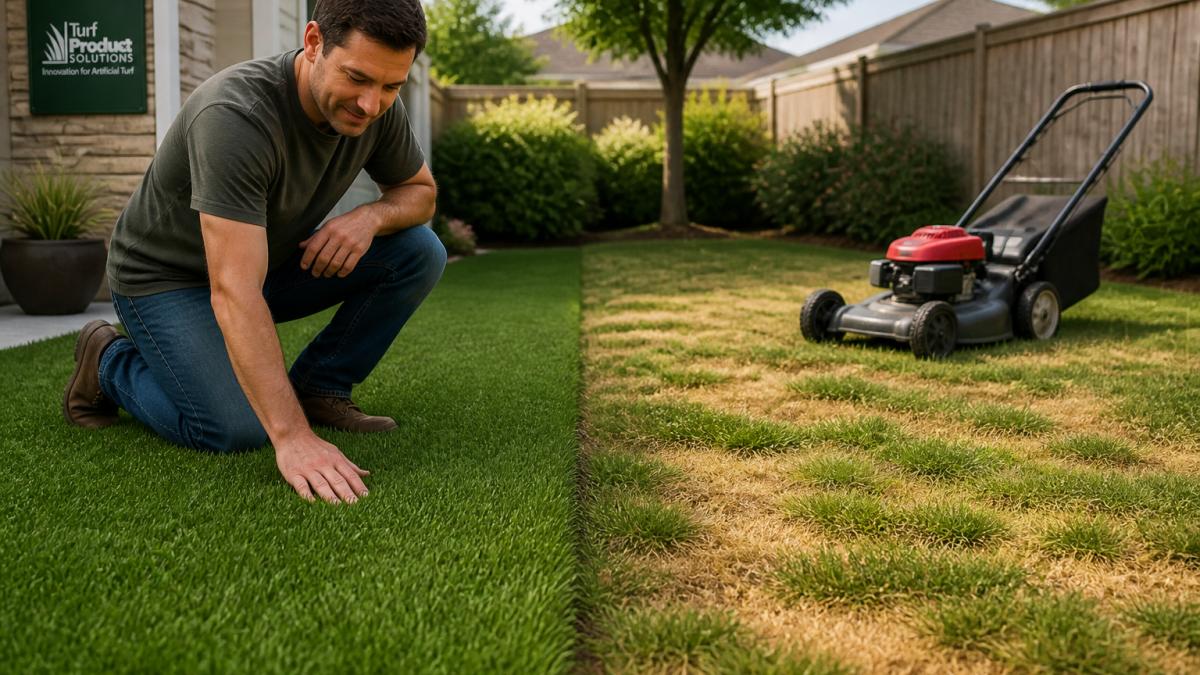
The average cost to install artificial grass in 2026 runs between $15 and $19 per square foot, materials and labor included, according to LawnStarter's 2026 artificial grass pricing analysis. That upfront number scares off plenty of homeowners. What they miss is the other side of the ledger: maintaining a natural grass lawn can cost $10,000 to $29,000 or more over a 10-year period once you add water, fertilizer, and labor, per AGL Grass's long-term upkeep analysis. At Turf Product Solutions, we've spent two decades watching this comparison get argued badly on both sides. So here's the honest artificial grass vs natural lawn maintenance costs breakdown, year by year, with the repair and disposal bills most comparisons quietly skip.
Upfront Installation Costs vs Long-Term Savings
Artificial turf wins the 10-year math in most climates, but only if you survive the upfront hit. Natural grass is cheaper on day one; artificial turf trades a higher check today for lower annual bills later. The catch is that "day one" and "year ten" are the only two numbers most comparisons give you.

What You Pay Before Maintenance Even Starts
Natural grass installation runs a fraction of synthetic turf's cost, but it isn't free: soil prep, grading, sod or seed, starter fertilizer, and an irrigation system that needs a backflow test, winterization, and eventual head replacement. A 1,000-square-foot natural lawn runs a few hundred dollars in materials if you seed it yourself, and several times that if you sod it and hire out the irrigation.
The Breakeven Point: When Does Turf Pay for Itself?
Breakeven typically lands between year five and year eight for a 1,000-square-foot yard in an average-water-cost market. It moves earlier in drought-prone regions with tiered water pricing and later in mild, rainy climates where natural grass mostly grows itself. A 2026 analysis from EverTurf's artificial grass vs real grass ROI study identifies a specific breakeven point where long-term savings overtake the higher upfront investment. Meanwhile, a 2025 MDPI sustainability case study found natural grass can actually cost less over a full 25-year lifecycle, because synthetic turf needs replacing around year 15 to 20 while organic grass management keeps going. Both can be true. The 10-year window favors turf; the 25-year window is a coin flip that depends on how you handle the replacement bill.
The 10-Year Ledger, Line by Line
Here is the part most comparisons skip: the cumulative total, not the annual average. The table below uses a 1,000-square-foot yard and mid-range 2026 pricing.
| Cost Category | Natural Grass (10-yr) | Artificial Turf (10-yr) |
|---|---|---|
| Upfront installation | Lower (seed/sod + irrigation) | $15,000-$19,000 at $15-$19/sq ft |
| Annual inputs (water, fertilizer, weed/pest control) | ~$816/yr before labor | $0 |
| Annual labor (mowing, edging, trimming) | $0 if DIY, $1,200-$2,400 if hired | $150-$300/yr total upkeep |
| Aeration / overseeding / renovation | Every 2-3 years | N/A |
| Infill top-up | N/A | $100-$300 every 1-2 years |
| Repair (seams, patches, reseeding) | Ongoing, small | Occasional, larger |
| Replacement / disposal | None | Every 15-20 years |
| 10-year total (DIY labor) | ~$8,000-$12,000 | ~$17,000-$22,000 |
| 10-year total (hired labor) | ~$20,000-$29,000 | ~$17,000-$22,000 |
The DIY row surprises people. If you mow your own lawn, the natural-grass column stays competitive through year 10. If you pay a service, turf pulls ahead decisively, and the gap widens every year past year eight.
What the Table Doesn't Show
The 10-year ledger assumes nothing goes wrong. It excludes a mid-life irrigation repair on the natural side, a seam failure on the turf side, drought-restricted water rates that can double in a single summer, and the disposal bill at year 15-20, the single most overlooked line in any turf cost projection. Run the table with your own numbers and the "which is cheaper" question usually answers itself.
Water, Mowing, and Fertilizer: Where Natural Grass Costs Add Up
Water, mowing, and fertilizer form the three-headed monster of natural lawn care expenses. Annual maintenance can reach 60% of the original installation cost, per Quora community cost research, which means a $6,000 lawn quietly bills you $3,600 every year.
The Southwest Greens analysis broke down annual inputs on a natural lawn: $360 for irrigation, $207 for fertilizer, $150 for pre-emergent weed control, and $99 for pesticides and herbicides, $816 per year before you pay anyone to mow it. Utility bills climb in drought years and mowing frequency spikes every spring. Artificial turf eliminates all three line items.
How to Maintain Artificial Turf Grass Without Hidden Expenses
Learning how to maintain artificial turf grass is simpler than most new owners expect, and it costs far less than natural lawn care: debris removal, fiber lifting, and periodic cleaning with a pet-safe product. Consistent upkeep prevents the long-term degradation of synthetic surfaces, a stark contrast to the fluctuating professional lawn care costs associated with managing traditional grass.
Annual Turf Maintenance Costs by Task
| Task | Frequency | Annual Cost |
|---|---|---|
| Debris sweeping | Weekly | $0 (own tool) |
| Rinsing and spot cleaning | Monthly | Included in cleaner |
| Enzyme deodorizing | Monthly to quarterly | $45-$110 |
| Infill top-up | Every 1-2 years | $100-$300 |
| Fiber lifting | Seasonal | $0 (own tool) |
A gallon of Turf Animal ORIGINAL, our plant-based enzyme cleaner, treats up to 8,000 square feet of heavy odor areas and costs $44.96. For larger properties, the Turf Animal PRO STRENGTH Starter Pack covers roughly 5,000 square feet per mix at $54.95.

Artificial Turf Maintenance Tools: What You Need and What They Cost
Two tools cover nearly every artificial turf maintenance task: a power sweeper for debris and fiber lifting, and an enzyme cleaner for odors. Buying both costs less than a single season of natural lawn service contracts.
The Turf Power Sweep MAX runs $589.95 and ships with a free Turf Power Jet. It uses a 40V cordless system with 5Ah batteries, FiberLift nylon brush technology, a built-in collection bag, and five adjustable height settings. No gas, no fumes, no engine maintenance. For tighter budgets, the Fiber Lift Pro at $289.95 handles fiber lifting and edge cleanup with a 17.3-inch nylon brush head on the same 20V battery platform.

For anyone new to turf ownership, The Artificial Turf Owners Manual by Nick Ogilvie costs $9.99 and covers the five enemies of artificial turf plus maintenance routines for pet areas, sports fields, and playgrounds.
Repair, Replacement, and Disposal: The Costs Most Comparisons Skip
Repair and disposal costs are where the artificial turf vs natural lawn debate gets dishonest. Most comparisons stop at year 10 and pretend the turf lasts forever, omitting the end-of-life costs that decide whether turf actually wins the 25-year math.
Turf Power Sweep™ MAX + FREE Turf Power Jet™ →
Artificial Turf: Repair Costs Over a 10-Year Window
Synthetic turf is not maintenance-free, it's maintenance-deferred. The bills arrive in bursts instead of drips.
- Seam and edge repairs. Seams lift, edges pull, and pet areas develop depressions. A localized patch or re-glue typically runs a few hundred dollars per visit, and most owners see one or two over a decade.
- Infill top-up. $100-$300 every one to two years; skipping it accelerates fiber matting and shortens the turf's usable life.
- Drainage and base repairs. If the base wasn't compacted correctly, water pools and the turf has to be lifted to fix it. This is the expensive one, it can run into four figures and is almost always a workmanship problem, not a product problem.
- Pet-area replacement. High-traffic pet zones often need partial replacement before the rest of the lawn does. A common pattern is replacing the pet zone at year 7-10 while the rest of the yard is still fine.
Natural Grass: The Repair Costs That Hide in Plain Sight
Natural grass doesn't have a disposal bill, but it has a renovation cycle most comparisons ignore.
- Aeration. Core aeration every one to three years to relieve compaction. DIY rental is cheap; a service call is not.
- Overseeding. Bare patches from pets, traffic, or disease need seed and consistent watering to establish. Seed is inexpensive; the water and the wait are not.
- Dethatching and topdressing. Needed when thatch builds up, which it does faster in humid climates.
- Disease and pest treatment. Fungus, grubs, and chinch bugs are recurring costs in many regions, not one-time events.
- Full renovation. Every 10-15 years, most natural lawns need more than patching, they need re-grading, re-seeding, or re-sodding. That's the natural-grass equivalent of turf replacement, and it's rarely priced into the comparison.
Disposal and End-of-Life: The Bill Nobody Quotes
When synthetic turf reaches the end of its life, typically year 15 to 20 for residential installations, it has to come out: cutting the turf into sections, hauling it off, and disposing of it.
Natural grass has no disposal bill, but it has a disposal equivalent: yard waste, old sod, removed thatch. In most municipalities this is curbside or compostable at low or no cost, a genuine financial advantage that rarely gets credited in these comparisons.
The Replacement Cycle Math
Here's the honest 25-year picture. Turf installed in year 1 gets replaced around year 15-20, so a 25-year projection includes one full replacement plus one disposal. Natural grass gets renovated around year 10-15 and again around year 20-25, but each renovation is cheaper than a turf replacement and produces compostable waste instead of landfill waste. Over 10 years, turf usually wins on total cost.
How to Compare Repair and Disposal Honestly
When evaluating quotes, ask every installer three questions:
- What is the removal and disposal cost per square foot at end of life, in today's dollars?
- What is the expected replacement year for this specific product in this specific climate?
- What repairs are excluded from the warranty, and what do those typically cost?
For natural grass, ask how often the lawn needs aeration and overseeding, the renovation cycle in this climate, and the cost of a full re-sod if the lawn fails. Answer both sets and the comparison stops being a sales pitch and starts being a budget.
Property Value and Curb Appeal: Does Turf Help or Hurt Resale?
Curb appeal is the wildcard here. Well-maintained artificial turf photographs beautifully and holds color year-round, which helps landscaping ROI in drought-prone markets where buyers want low-water yards. Poorly maintained turf, matted and smelling of pet urine, does the opposite and can become a negotiating point against you.
The global artificial turf market is projected to grow from $7.8 billion in 2026 to $13.7 billion by 2033, per Grand View Research's artificial turf market report, which tells you buyer acceptance is rising. Property value impact depends less on which surface you pick and more on how it looks on inspection day. A $300 annual maintenance budget protects a five-figure installation. That's the whole argument in one sentence.
The real challenge isn't choosing between artificial grass and a natural lawn. It's protecting whichever surface you already own from the costs that quietly pile up. Turf Product Solutions builds the tools that keep that number down: the 40V cordless Turf Power Sweep MAX with FiberLift brush technology, plant-based Turf Animal enzyme cleaners that are safe for pets and kids, and the Artificial Turf Owners Manual written by founder Nick Ogilvie after more than 20 years in the industry. Get started with Turf Product Solutions and keep your turf looking installed-fresh for years, not months.
Frequently Asked Questions
Is artificial grass cheaper to maintain than natural grass?
Yes, in most cases. Artificial turf maintenance costs average $150 to $300 per year. Natural grass can run $360 annually for irrigation alone, plus $207 for fertilizer, $150 for pre-emergent, and $99 for pesticides and herbicides, based on Southwest Greens data. Over a decade, natural lawn care can reach $10,000 to $29,000 or more, per AGL Grass (2024). The gap widens when you factor in mowing labor and water bills.
How much does it cost to maintain artificial turf annually?
Budget $150 to $300 per year for routine artificial turf maintenance. That covers occasional rinsing, brushing to lift flattened fibers, and spot cleaning. If you have pets, add enzyme-based cleaner costs, though a concentrated gallon of Turf Animal at $44.96 treats up to 8,000 square feet. Battery-powered tools like the Turf Power Sweep MAX ($589.95) are a one-time purchase that replaces gas equipment and reduces long-term labor costs.
What are the hidden costs of natural lawn maintenance?
Beyond mowing and watering, natural grass carries costs homeowners often overlook. Add lawn aeration, weed control, chemical runoff management, and irrigation system repairs. Annual maintenance can hit 60% of the original installation cost, per community research from Quora (2024). Those numbers rarely appear in basic cost comparisons.
Does artificial grass increase home value?
Artificial turf can improve curb appeal and attract buyers in drought-prone markets where water conservation matters. However, the property value impact depends on your local market and buyer preferences. Some buyers prefer natural sod for gardening or pets. The financial case for turf rests more on lifetime cost savings than resale premium. Focus on installation quality and ongoing maintenance to keep turf looking its best for showings.
What tools are required for artificial turf maintenance?
You need a power broom or sweeper to lift flattened fibers and remove debris, a leaf blower for hard-to-reach areas, and an enzyme-based cleaner for pet odors. The Turf Power Sweep MAX ($589.95) combines sweeping and collection in one cordless unit with FiberLift nylon brush technology. For odor control, Turf Animal Original ($44.96 per gallon) uses plant-based enzymes to break down urine and bacteria at the source. A stiff-bristle brush handles spot cleaning between deep cleans.