
Table of Contents
- Why Artificial Grass Smells Like Pet Urine
- Comparison Table: Best Artificial Grass Deodorizer for Pets
- How to Remove Dog Urine Smell from Artificial Grass
- Why an Enzyme Cleaner for Artificial Grass Works Best
- Turf Animal: A Pet-Safe Deodorizer Built for Turf
- Artificial Grass Maintenance Tips for Pet Owners
- DIY vs. Professional Service: When to Call for Help
- Conclusion
- Frequently Asked Questions
Last Updated: September 20, 2026
Why Artificial Grass Smells Like Pet Urine
The best artificial grass deodorizer for pets solves a chemistry problem, not a surface problem. Urine pools in the infill and sub-base, where bacteria feed on urea and uric acid and produce ammonia, that buildup is what you smell, and heat worsens it.
Comparison Table: Best Artificial Grass Deodorizer for Pets
| Product | Price | Coverage | Best For |
|---|---|---|---|
| Turf Animal Original (1 Gallon) | $44.96 | Up to 8,000 sq ft | Heavy odor areas, dog runs |
| Turf Animal Original (3 Pack Quart) | $49.95 | 1,250 sq ft per quart | Small yards, spot treatment |
| Turf Animal PRO Starter Pack | $54.95 | ~5,000 sq ft | Bulk use, kennels, HOAs |
| Turf Animal PRO 4 Pack Refill | $94.95 | ~9,000 sq ft | Commercial and multi-site use |
Every option uses the same live enzyme formula; the difference is concentration and volume, not chemistry.

How to Remove Dog Urine Smell from Artificial Grass
Removing dog urine smell from artificial grass takes four steps: dilute, apply, let it dwell, and rinse. Skipping dwell time is the most common DIY mistake.
Step-by-Step Application
- Pick up solid waste first. Fecal matter left on the surface breaks down into the same odor compounds as urine.
- Pre-rinse with water. A light rinse clears loose debris and preps the blades. Do not soak the infill.
- Mix your concentrate. Follow the dilution ratio on the label. More is not better with enzymes.
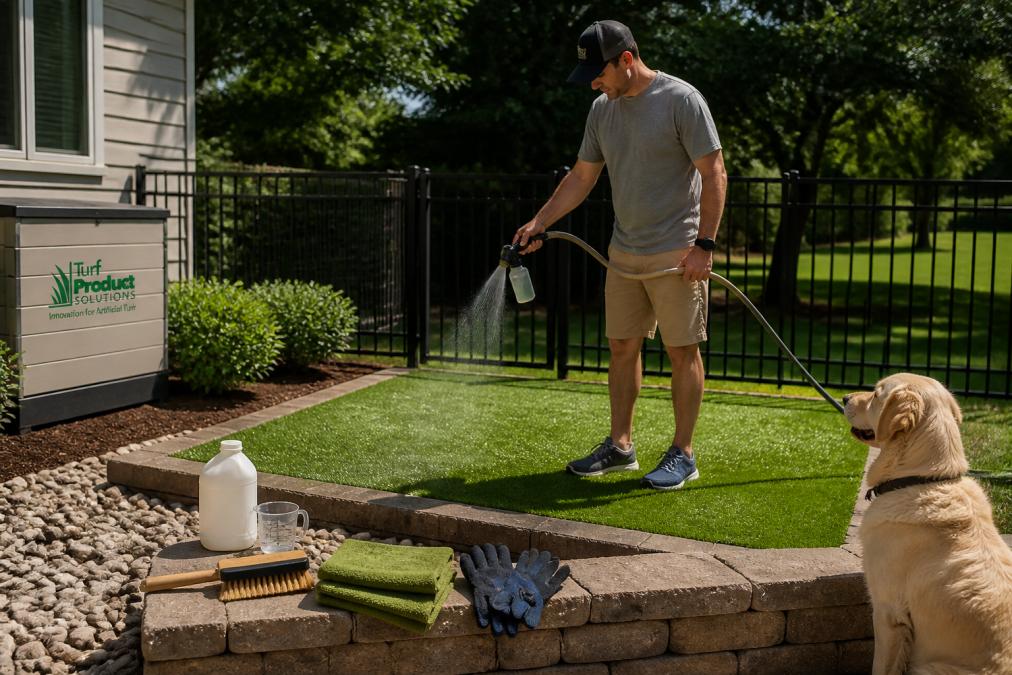
- Apply evenly. A hose-end sprayer covers large areas fastest. Work in overlapping passes.
- Let it dwell. Give the enzymes time to digest the odor-causing bacteria before you rinse.
Dwell Time and Rinse Cycle
Dwell time is how long the product stays wet before you rinse. Most enzyme formulas need the surface damp for bacteria to be digested; if the turf dries out mid-treatment, the process stops.
Why an Enzyme Cleaner for Artificial Grass Works Best
An enzyme cleaner for artificial grass is the most widely recommended product category for pet urine because it breaks down the source of the smell instead of covering it. Green Sweep Co.'s 2026 turf cleaning guide identifies enzyme-based cleaners as the leading recommendation for neutralizing pet urine at the source.
Live Bacteria vs. Masking Fragrances
Masking fragrances are the cheap shortcut: perfume fades in a day or two while bacteria keep producing ammonia.
Turf Animal: A Pet-Safe Deodorizer Built for Turf
Turf Animal is a plant-based enzyme cleaner built for synthetic turf and is the formula behind every product in our comparison table. It is pH-balanced to protect synthetic fibers, free from sulfates, dyes, and synthetic perfumes, and formulated to Whole Foods eco-ingredient standards.

Artificial Grass Maintenance Tips for Pet Owners
Consistent artificial grass maintenance tips matter more than any single deep clean. Turf treated lightly each week stays ahead of odor; turf cleaned only when it smells needs a much heavier application.
- Rinse waste spots the same day when possible
- Treat high-traffic zones weekly during warm months
- Brush blades upright so infill stays evenly distributed
- Check drainage after heavy rain for pooling
- Keep food and water bowls off the turf to reduce organic debris
Infill Compatibility: Match the Cleaner to the Fill
Most deodorizer guides treat all synthetic turf as one surface. It is not. The infill under the blades holds the urine, and different materials react very differently to the same cleaner. The wrong chemistry can clump the fill, strip an antimicrobial coating, or void a turf warranty.
Drainage Is Half the Equation
Drainage is the other half of the equation. If your sub-base does not move water, urine sits in the profile and no surface cleaner reaches it. Well-installed turf with a properly compacted aggregate base should drain efficiently; if yours pools after a hard rain, the base is the problem, not the cleaner.
Test drainage before you buy anything: pour a gallon of water on the worst spot and time how long it takes to disappear. If it takes more than a few minutes, fix drainage first.
Environmental Runoff: Where the Rinse Water Goes
Whatever you apply to the turf, enzyme residue, digested waste, oxidized ammonia, or leftover fragrance, drains through the infill and exits somewhere. On most residential installs that means runoff sheet-flows toward a lawn, planting bed, or storm drain.
(1 Gallon) Turf Animal ORIGINAL →
Three practical rules keep runoff benign:
- Use the lowest effective concentration. Enzyme products are diluted for a reason. Overdosing sends undigested chemistry into the soil and wastes product.
- Avoid oxidizers near edible gardens or storm drains. Hydrogen peroxide breaks down into water and oxygen, but it can be reactive on contact with soil biology and aquatic life. Rinse toward a lawn, not a curb.
- Skip bleach, quaternary ammonium, and phenolic disinfectants entirely. These are common in generic pet odor products and are toxic to soil microbes, harmful to aquatic organisms in stormwater, and can degrade turf backing over repeated use.
DIY vs. Professional Service: When to Call for Help
Most homeowners can handle odor control with a hose-end sprayer and a quality enzyme concentrate. The DIY threshold breaks down in three situations: persistent odor after two full treatments, drainage that fails the water test, or a commercial facility with daily animal traffic.
The DIY Zone
You can reasonably handle odor control yourself if all of the following are true:
- The smell is localized to one or two spots, not the whole lawn
- A gallon of water poured on the worst spot drains within a few minutes
- Odor improves noticeably after a single enzyme treatment with proper dwell time
- You have one or two dogs using the turf, not a rotating pack
- The turf is under five years old and the infill has not compacted into a hard crust
The Gray Zone: When to Escalate
Escalate to a professional turf restoration service if any of these apply:
- Odor returns within 48 hours of a correct treatment. This usually means urine has reached the sub-base, not just the infill. Surface cleaners cannot fix a saturated base.
- Drainage fails the gallon test on multiple spots. Compacted or clogged sub-base requires mechanical correction, aeration, top-dressing, or in severe cases partial turf removal and base rebuild.
- The infill has crusted or channeled. If brushing no longer redistributes the fill, urine is pooling in low spots and no sprayer will reach it evenly.
- Ammonia smell persists after rain. Rain should flush the profile. If it does not, the drainage layer is compromised.
- You have three or more dogs on a small run. The waste load exceeds what a residential maintenance schedule can process.
What a Professional Actually Does
A turf restoration service is not just a stronger sprayer. Such services may include:
- Deep extraction. A high-pressure rinse combined with a wet vacuum pulls diluted waste out of the infill and the top inch of base rather than pushing it deeper.
- Infill de-compaction and re-leveling. Power brooming and top-dressing restore even distribution so future treatments reach the whole surface.
- Sub-base inspection. If the aggregate base has failed, the pro identifies it before you spend another season on products that cannot work.
- Commercial-grade enzyme or oxidizer application. Applied at concentrations and dwell times that are impractical for a homeowner with a hose-end sprayer.
- Recurring maintenance contracts. Kennels, doggy daycares, and HOAs running high-volume turf usually need a scheduled program rather than reactive cleaning. That is where bulk Eco Bag formats and commercial-grade application equipment earn their cost.
The Cost Math
A professional restoration visit can cost more than a gallon of enzyme concentrate, but it may address underlying drainage or compaction problems. If you have already spent significantly on products that did not work, consider getting an inspection.
Commercial and Multi-Dog Operations
Kennels, boarding facilities, doggy daycares, and HOAs with shared turf should skip the DIY phase entirely. Daily animal traffic saturates infill faster than any homeowner schedule can keep up with, and persistent ammonia odor on a shared surface is a liability not worth the savings. These operations need a written maintenance program with defined treatment intervals, documented products, and a service provider who can respond between scheduled visits.
Conclusion
Persistent pet odor on synthetic turf is a drainage and bacteria problem, and it will not resolve with fragrance or extra rinsing. The fix is a live enzyme formula applied correctly, with enough dwell time to digest the source.
Frequently Asked Questions
What is the best pet-safe deodorizer for artificial grass?
Enzyme-based cleaners are the most widely recommended option for artificial turf because they use live bacteria and enzymes to break down odor-causing compounds rather than masking them. Turf Animal Original is a plant-based, pH-balanced formula that digests pet urine and organic waste at the source. It is free from sulfates, dyes, and synthetic perfumes, making it safe for pets and children. A one-gallon concentrate treats up to 8,000 square feet for heavy odor areas.
How do I stop my fake grass from smelling of dog urine?
Start by removing solid waste promptly, then apply an enzyme cleaner for artificial grass that targets ammonia buildup and bacteria in the infill. Turf Animal's live enzyme formula breaks down uric acid crystals that regular hose rinses leave behind. For best results, apply with a hose-end sprayer, allow the recommended dwell time, and rinse thoroughly. Repeat every two to four weeks in high-traffic dog areas to prevent odor from returning.
Are enzyme-based cleaners better for artificial turf?
Enzyme cleaners are the most widely recommended product category for artificial turf because they neutralize odor at the source instead of covering it with fragrance. Live bacteria and enzymes digest organic waste, including pet urine and fecal matter, that collects in the infill and turf backing. Unlike harsh oxidizers or quats, a pH-balanced enzyme formula like Turf Animal protects synthetic fibers and is safe for sensitive paws.
How often should I deodorize my artificial grass?
For a single dog using a moderate-sized yard, deodorizing every two to four weeks with an enzyme cleaner keeps odor under control. Dog runs, kennels, and multi-pet households may need weekly applications. Turf Animal's concentrate covers up to 8,000 square feet per gallon, and the Eco Bag refill system offers a lower cost per application for routine maintenance programs. Adjust frequency based on how many pets use the turf and how quickly odors return.