
Table of Contents
- Why Artificial Grass Needs More Than a Rinse
- Quick Comparison: Best Eco Friendly Artificial Grass Cleaner Options
- How to Remove Dog Urine Smell from Artificial Grass
- Enzymatic Turf Cleaner Benefits: Why Live Enzymes Work
- Best Tools for Artificial Grass Cleaning: Sweepers and Sprayers
- How to Pick the Best Eco Friendly Artificial Grass Cleaner for Your Yard
- Frequently Asked Questions
Last Updated: September 16, 2026
Why Artificial Grass Needs More Than a Rinse
Artificial turf can cut water use by up to 70% compared with a natural lawn, according to Artificial Turf Supply's sustainability data, yet that same surface traps everything your dog, your kids, and the weather leave behind. At Turf Product Solutions, we've spent years watching homeowners hose down turf and wonder why the smell returns by afternoon. Rinsing moves waste around; it doesn't break it down.
Quick Comparison: Best Eco Friendly Artificial Grass Cleaner Options
The best eco friendly artificial grass cleaner for most homes is a concentrated live-enzyme formula applied with a hose-end sprayer. Coverage and packaging matter as much as the formula: too weak or too wasteful costs more over a season.
| Product | Price | Coverage | Best For |
|---|---|---|---|
| Turf Animal Original, 1 Gallon | $44.96 | Up to 8,000 sq ft | Most pet-owning households |
| Turf Animal Pro Strength Starter Pack | $54.95 | ~5,000 sq ft | First-time buyers wanting a sprayer |
| Turf Animal Original, 3 Pack Quart | $49.95 | ~3,750 sq ft | Smaller yards, indoor trigger use |
| Turf Animal Pro Strength, 4 Pack Refill | $94.95 | ~9,000 sq ft | Kennels and installers |
What "Eco Friendly" Actually Means on a Turf Cleaner Label
Most guides call a product eco friendly and move on, but the label rarely explains what that means. Here's what separates a genuinely low-impact turf cleaner from a green-marketed one:

- Biodegradability of the surfactant. Surfactants let a cleaner wet synthetic blades and lift residue. Plant-derived surfactants (coconut, corn, and sugar-based) break down in soil and drainage within days; synthetic surfactants like APEs and NPEs persist longer, accumulate in runoff, and are restricted in several states.
- Enzymatic vs. oxidative chemistry. Enzyme and microbial formulas digest uric acid and organic waste into carbon dioxide and water. Chlorine, peroxide, and quaternary ammonium cleaners oxidize or kill on contact, then leave a residue film on backing and infill.
- Fragrance and dye load. Synthetic perfumes and dyes are the most common sources of contact irritation on turf and do nothing for odor at the source. Fragrance-free, dye-free formulas are the safer default for households with pets and small children.
- PFAS and 1,4-dioxane screening. PFAS are a headline issue for artificial turf itself. A cleaner that is PFAS-free and screened for 1,4-dioxane avoids adding a second contaminant to the same surface.
- Concentrate vs. RTU packaging. A concentrate shipped in a single gallon jug uses roughly 80% less plastic per treated square foot than the equivalent volume of ready-to-use spray bottles, often the biggest environmental difference between two similar formulas.
How the Four Options Compare on Those Criteria
All four Turf Animal SKUs share the same eco profile: live enzymes plus microbes, plant-derived surfactants, pH-balanced, and free from sulfates, dyes, and synthetic perfumes. They differ only in packaging and concentration.
- 1 Gallon Original ($44.96, up to 8,000 sq ft), lowest cost per square foot. Best for a single-dog backyard treated weekly with a fresh mix.
- Pro Strength Starter Pack ($54.95, ~5,000 sq ft), includes a hose-end sprayer, removing the most common application error (uneven dilution). Best first purchase.
- 3 Pack Quart Original ($49.95, ~3,750 sq ft), trigger sprayer format. Best for patios, balconies, and indoor accidents.
- 4 Pack Refill Pro Strength ($94.95, ~9,000 sq ft), highest coverage and lowest plastic per application. Best for kennels, boarding facilities, and installers.
How to Remove Dog Urine Smell from Artificial Grass
Removing dog urine smell from artificial grass means breaking down uric acid at the source, not covering it. Dilute a live-enzyme concentrate, saturate the affected zone, and let it dwell long enough to digest the residue before rinsing.
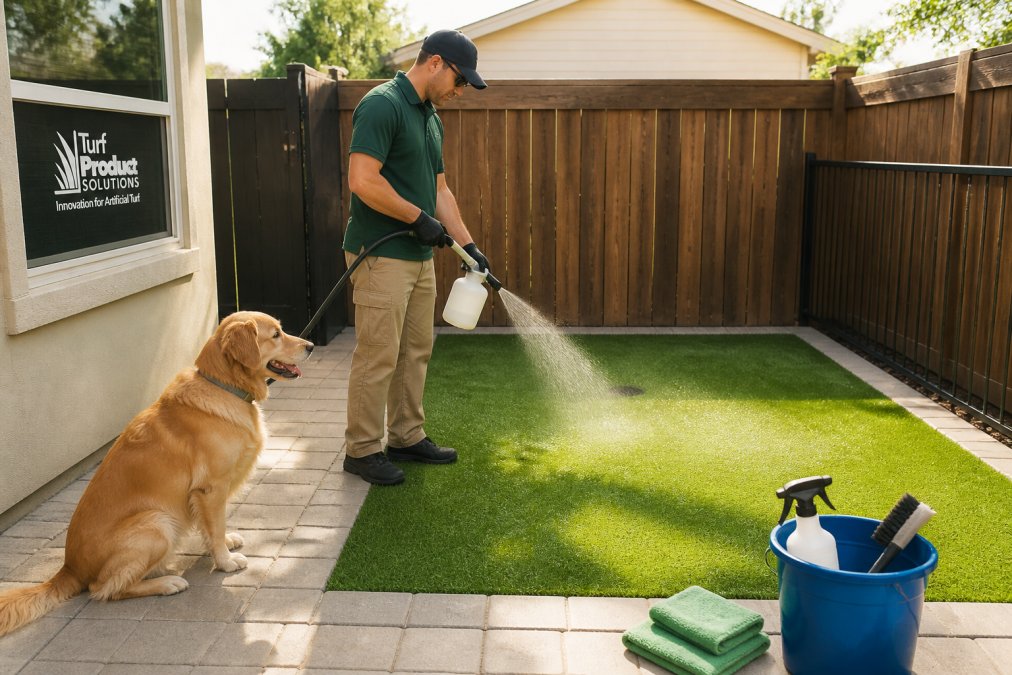
Four steps handle most problem spots:
- Remove solid waste and rinse loose debris off the blades.
- Mix the concentrate at the label dilution ratio and apply with a hose-end sprayer.
- Let it dwell so the enzymes digest uric acid and bacteria.
- Rinse and let the drainage system carry residue away.
Why Uric Acid Is So Hard to Remove
Uric acid is not water-soluble the way most people assume. It forms crystals that bind to the polyethylene blades and infill granules, sitting below the blade line where a hose never reaches, and bacteria convert it to ammonia gas, what you actually smell. Rinsing re-wets the crystals without breaking them down; enzymes cleave the uric acid molecule itself, so the ammonia precursor is gone rather than diluted.
Climate Changes the Dwell Time
Heat and humidity drive how fast enzymes work and how fast your solution evaporates, so the same dilution can underperform in another region.
- Hot, arid climates (Southwest, inland West): Turf surfaces run well above ambient air temperature on a sunny afternoon, and a diluted enzyme solution can evaporate before it reaches the infill. Apply at dawn or after sunset, pre-wet the turf so the solution soaks in instead of beading, and plan two lighter passes rather than one heavy one.
- Hot, humid climates (Southeast, Gulf Coast): Evaporation is less of a problem, but bacterial activity is higher, so ammonia returns faster. Increase frequency rather than concentration, weekly in peak summer for active dog runs, and watch shaded areas where moisture and odor compounds concentrate.
- Cool, wet climates (Pacific Northwest, upper Midwest): Enzymes work more slowly at lower temperatures. Extend dwell time, and avoid treating right before heavy rain that washes the solution through drainage before it finishes working.
- Freeze-risk regions: Do not apply when the surface is at or below freezing. Enzymes go dormant, and the solution can freeze in the sprayer and crack it.
Infill and Drainage Determine How You Rinse
Not all artificial turf drains the same way, and how you rinse should follow the construction:
- Silica sand infill holds moisture and odor compounds longer than coated or rubber infill. It needs more dwell time and a slower, more thorough rinse.
- Zeolite or coated antimicrobial infill actively adsorbs ammonia. It extends the interval between treatments but can become saturated, so a periodic deeper treatment is still required.
- Rubber crumb infill drains quickly but can retain odor in the crumb itself. Saturate rather than surface-spray.
- Backing and drainage base: Turf over a compacted aggregate base with perforated backing drains fast and tolerates a heavy rinse. Turf over a solid or poorly draining base ponds, and ponding restarts odor problems. If water stands more than a few minutes after a rinse, reduce rinse volume and increase dwell time.
A Repeatable Treatment Schedule
For an active dog run: spot-treat accidents the same day, run a full enzyme treatment weekly through the warm months, and drop to every two to three weeks once temperatures fall. In humid regions, keep the weekly cadence longer into the season; in arid regions, shift to cooler hours and pre-wet the surface. The goal is not a stronger mix but a consistent one that reaches the infill before it dries.
(1 Gallon) Turf Animal ORIGINAL →
Enzymatic Turf Cleaner Benefits: Why Live Enzymes Work
Enzymatic turf cleaners work because enzymes are biological catalysts: they break the chemical bonds in uric acid and organic waste, converting odor-causing compounds into harmless byproducts. Bacterial microbes in the same formula consume what's left.
Best Tools for Artificial Grass Cleaning: Sweepers and Sprayers
The best tools for artificial grass cleaning pair mechanical debris removal with chemical odor control. A battery-powered turf sweeper lifts leaves, pet hair, and organic matter out of the infill; a hose-end or trigger sprayer applies your enzyme cleaner evenly.
How to Pick the Best Eco Friendly Artificial Grass Cleaner for Your Yard
Here's how the Turf Product Solutions lineup maps to common situations:
| Your Situation | Recommended Product | Why |
|---|---|---|
| One dog, average backyard | 1 Gallon Turf Animal Original | Best cost per sq ft at $44.96 |
| First purchase, want a sprayer included | Pro Strength Starter Pack | Hose-end nozzle included, $54.95 |
| Small patio or indoor accidents | 3 Pack Quart Original | Trigger sprayer included, $49.95 |
| Kennel or installer route | 4 Pack Refill Pro Strength | ~9,000 sq ft at $94.95 |
For large turf areas, mix only what you'll use in one session. Enzymes lose potency once diluted, so a fresh batch outperforms a sprayer left sitting overnight.

Frequently Asked Questions
What is the best thing to clean artificial grass with?
For pet owners and families, the best option is a pH-balanced, plant-based enzyme cleaner. These formulas break down uric acid and organic waste at the source rather than masking odors with heavy fragrances. Look for products free from sulfates, dyes, and synthetic perfumes. A concentrate like Turf Animal covers up to 8,000 sq ft per gallon, making it cost-effective for regular maintenance.
Is there an enzymatic cleaner that can be used on artificial grass?
Yes. Live enzyme cleaners are specifically designed for synthetic turf. They use bacterial microbes and enzymes to digest uric acid, ammonia, and organic buildup without degrading turf fibers. Unlike harsh oxidizers or quats, enzyme formulas are pH-balanced and safe for pets and children. They work best when applied, allowed to dwell, and then rinsed through the drainage system.
How often should you deep clean artificial turf?
Most homeowners should deep clean artificial turf every 4 to 6 weeks, depending on pet traffic and climate. High-use areas like dog runs may need monthly treatment. During hot or humid months, ammonia buildup accelerates, so increase frequency. A routine of weekly debris removal with a power sweeper and monthly enzyme treatment keeps turf fresh and extends its lifespan.
Are eco-friendly turf cleaners safe for pets and children?
Eco-friendly cleaners made with plant-based enzymes and natural surfactants are safe for pets and children when used as directed. They contain no harsh chemicals, synthetic dyes, or perfumes. Products like Turf Animal are pH-balanced to protect synthetic fibers and leave no slippery residue. Always check the label for non-toxic, biodegradable claims and follow the dilution ratio.
What ruins artificial grass?
Artificial grass can be damaged by harsh chemicals like chlorine, iodine, and quats, which degrade synthetic fibers and cause fading. High heat can also soften blades, and poor drainage leads to mold and bacteria. Using a pH-balanced enzymatic cleaner and avoiding abrasive scrubbing helps preserve turf longevity. Regular rinsing prevents surface residue and keeps infill clean.