
Table of Contents
- Why Standard Infill Fails With Dogs
- Top Infill Options for Artificial Turf With Dogs
- Zeolite Infill for Dogs: What Makes It Different
- Silica Sand vs Zeolite for Pets
- How to Clean Artificial Turf With Dogs
- Climate, Budget, and Installation Considerations
- Frequently Asked Questions
Last Updated: September 14, 2026
Why Standard Infill Fails With Dogs
The best infill for artificial turf with dogs is a zeolite-based or antimicrobial-coated product, not the silica sand most installations ship with. That swap solves the two problems dog owners complain about most: ammonia odor and surface heat.
Silica sand and tire crumb exist to hold turf fibers upright and add ballast. According to MDPI's artificial turf versus natural grass case study, those materials are "primarily used to enhance the structural stability" of the system. Stability is not sanitation.
Dog urine drains through the backing and pools in the infill layer, where bacteria convert urea into ammonia. Sand holds moisture and offers no antimicrobial defense, so the smell returns within days of every rinse, a complaint Turf Product Solutions hears constantly from homeowners who assumed a hose-down was enough.
Heat compounds the problem. Dark crumb rubber and sand absorb sunlight and radiate it back at paw level, which matters on a surface your dog uses several times a day.
Top Infill Options for Artificial Turf With Dogs
Three materials dominate pet-specific installations in 2026: zeolite, antimicrobial coated sand, and rubber-based infills. The right pick depends on whether odor, heat, or budget drives your decision.
| Infill | Odor Control | Cooling vs. Sand | Best For |
|---|---|---|---|
| Zeolite | Excellent (ammonia absorption) | 20-30% cooler | Multi-dog households |
| Coated antimicrobial sand | Very good | Moderate | Humid climates |
| Crumb rubber / EPDM | Poor | Absorbs heat | High-traffic durability |
Zeolite: Odor Control Champion
Zeolite is a porous volcanic mineral that traps ammonia molecules inside its structure instead of letting them escape as gas. Industry guidance from Magnolia Turf's infill selection guide now favors zeolite-based products over basic sand specifically for drainage and odor neutralization.
It is the closest thing to a set-and-forget option, though you must replenish it periodically as the mineral's binding sites fill up.
Antimicrobial Coated Sands
Coated sands carry a built-in antimicrobial layer, and products like Envirofill are increasingly marketed with Microban technology to reduce bacteria and odor (The Motz Group on antimicrobial infill trends). They cost less than zeolite and handle drainage well.
The trade-off is cooling. Coated sand does not reflect heat the way zeolite does, so it suits shaded runs better than full-sun lawns.
Crumb Rubber and EPDM
Rubber infills win on durability and cushioning under heavy traffic, but lose on heat retention, and neither crumb rubber nor EPDM neutralizes ammonia. Acceptable for a single small dog in shade; not for three dogs in direct sun.
Zeolite Infill for Dogs: What Makes It Different
Zeolite infill for dogs works because of structure, not chemistry: the mineral has a honeycomb lattice that physically captures ammonia before it becomes airborne.
Cooling is the second advantage. Zeolite-based products run roughly 20% to 30% cooler than standard silica sand in direct sunlight, according to TurfFresh's infill thermal performance analysis. On a 95-degree day, that difference is the gap between a usable lawn and one your dog avoids.
One limitation: zeolite costs more per bag than silica sand, and a dedicated dog run needs a deeper layer than a decorative lawn.
Silica Sand vs Zeolite for Pets
Silica sand is the cheapest way to stabilize turf fibers; zeolite is the better choice for any yard a dog actually uses.
Sand handles ballast and blade uprightness at the lowest cost per square foot. It does nothing for ammonia absorption, and it holds moisture longer than a porous alternative, which encourages bacterial growth in the infill layer. Pet-specific guidance from PetGrows on turf sand versus zeolite notes that silica sand is increasingly supplemented or replaced by zeolite in pet installations for exactly this reason.
Zeolite absorbs ammonia, drains faster, and runs cooler. A 50lb bag of a pet-specific product like HeroFill runs around $23 based on user-reported pricing in r/landscaping, though pricing varies by region and quantity.
The practical answer: use sand as your base if the budget is tight, then top-dress with zeolite where the dogs actually go.
How to Clean Artificial Turf With Dogs
Cleaning pet turf is a three-part routine: remove solids daily, flush the infill weekly, and replenish the infill layer seasonally. Skip any step and odor returns regardless of which infill you chose. The reason is mechanical: urine carries urea, bacteria convert urea to ammonia, and ammonia binds to whatever surface it touches. Infill with active binding sites (zeolite) captures it; infill without them (silica sand, crumb rubber) lets it re-release as gas every time the surface warms up.
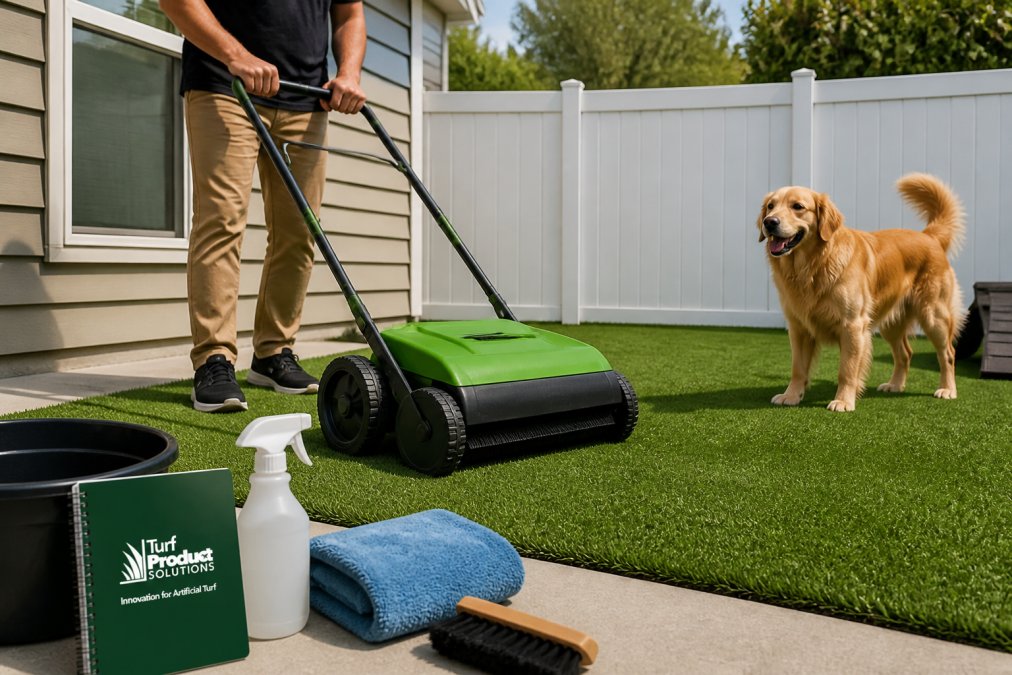
- Remove solids immediately. Pick up waste before it breaks down. A leaf rake or battery-powered turf sweeper lifts debris without disturbing the infill. Waiting even a day lets residue smear into the fibers, where it is much harder to rinse out.
- Rinse the zone, not the whole lawn. Flood the affected area and let it drain through the porous backing. A light spray only wets the surface; you want enough volume to carry dissolved urea past the infill layer into the sub-base. For a marking dog, the same two or three spots get rinsed far more often than the rest of the lawn.
- Apply a live enzyme cleaner. Enzymes break down the uric acid crystals that hold odor. A hose alone dilutes the surface but leaves the crystals intact, and those crystals re-activate every time humidity rises. This is the step most homeowners skip, and the reason odor returns within days of a rinse.
- Brush the fibers upright. A stiff broom restores blade uprightness and redistributes infill after rinsing. Matted fibers trap moisture against the backing, exactly where bacteria want to be.
- Top-dress with fresh infill. Add zeolite or coated sand to high-traffic zones twice a year. Infill migrates and compacts, so depth drops even when the material still has binding capacity.
Adjusting the Routine for Dog Behavior
Not every dog uses the lawn the same way, and the maintenance schedule should reflect that.
Markers. Dogs that urinate in the same spot multiple times a day concentrate the ammonia load. Those zones need rinsing every few days, not weekly, and benefit most from a zeolite top-dress because the mineral's binding sites do the heavy lifting.
Diggers. Digging displaces infill faster than any other behavior. Replenish dug zones monthly, and consider a slightly deeper infill layer there so a single dig does not expose the backing.
Puppies and seniors. Both tend to have more frequent, less controlled urination. A puppy in training may produce several small urine events per day in the same area, functionally similar to a marking dog in ammonia concentration.
Multi-dog households. Two or more dogs roughly double the ammonia load. Scale cleaning frequency to the number of dogs, not the size of the lawn.
This is where equipment matters. Turf Product Solutions provides professional-grade maintenance tools and eco-friendly cleaning solutions designed to keep artificial turf in peak condition. Our 40V battery-powered Turf Power Sweep offers no fumes and no pull cord, and our specialized live enzyme cleaners are safe for pets and families.
Climate, Budget, and Installation Considerations
Climate decides your infill more than budget does. The zeolite that saves a yard in Phoenix can underperform in a humid coastal climate if the sub-base does not drain, and the coated sand that works in Seattle can bake paws in a full-sun Texas yard. Match the material to the environment first, then the budget. Beyond the turf, the natural properties of zeolite in soil can further assist in managing moisture and nutrient levels throughout the surrounding landscape.
Climate-Specific Infill Recommendations
Humid and rainy climates. Standing moisture is the enemy. Prioritize coated antimicrobial sand or zeolite paired with a porous backing and compacted aggregate sub-base, without permeability below the turf, even the best infill sits in a bathtub. A common pattern is a 1- to 2-inch layer of 3/8-inch clean crushed stone under the turf, topped with geotextile fabric, then the infill. Skip the fabric and fines migrate upward and clog drainage.
Hot, dry, high-sun climates. Heat reflection does more work than any other upgrade. Zeolite's 20% to 30% cooler surface versus silica sand matters most here, because paw-level radiant heat is the difference between a usable lawn and one the dog avoids from noon to 4 p.m. Light-colored coated sands also reflect more solar energy than dark crumb rubber, which absorbs and re-radiates heat.
Cold climates with freeze-thaw cycles. Drainage still matters, for a different reason: saturated infill expands when it freezes and gets pushed toward the surface, frost heave. Over a few winters, that migration leaves high spots, thin spots, and exposed backing. A well-draining sub-base and slightly deeper infill layer reduce how often you top-dress.
Transitional and mixed climates. Most of the country falls here. Zeolite is the safest default: it performs acceptably across humidity and heat ranges and needs no seasonal swap.
Budget: What You Are Actually Paying For
Infill is sold by weight, and cost per square foot depends on install depth. A decorative lawn may need only a light top-dressing, while a dedicated dog run needs a deeper layer to buffer urine load and traffic, so the same bag goes much further on a front yard than on a 10-by-20-foot kennel run.
Compare the two-year cost, not the per-bag cost. Cheap silica sand plus weekly enzyme cleaner plus twice-yearly replacement often costs more than zeolite installed once and top-dressed occasionally. Crumb rubber looks cheap upfront but offers no ammonia neutralization, so odor-control cost shifts entirely to cleaners and water.
DIY vs. Professional Installation
Most homeowners can top-dress an existing lawn themselves with a stiff broom, a drop spreader or scoop, and a few bags of infill. If the turf is already laid and draining well, you only need infill, no excavation, compaction, or specialized equipment.
Full replacement is a different job. Sub-base grading, compaction in lifts, and edge restraint require a plate compactor, a laser level or transit, and experience reading drainage slope. Common DIY mistakes: skipping compaction, which lets the sub-base settle unevenly and creates low spots where urine pools, and installing turf over bare soil without a weed barrier, which lets weeds push through within a season.
A simple self-assessment: after heavy rain, does water pool anywhere for more than an hour? If yes, the sub-base is the problem, not the infill, and no amount of zeolite will fix it. If water drains within minutes, you are a top-dress candidate and can handle the job yourself.
One more consideration: environmental impact and long-term material health. Zeolite is a naturally occurring mineral that does not leach the way tire-derived crumb rubber can, and it is non-toxic to pets and children. Crumb rubber has drawn scrutiny over potential respiratory and skin irritants from off-gassing and dust, particularly in enclosed or poorly ventilated areas. For a yard where dogs and kids play daily, a natural mineral or coated sand is the lower-risk choice.
Frequently Asked Questions
What is the best infill for artificial turf with dogs?
Zeolite-based infills and antimicrobial coated sands perform best for dog turf. Zeolite traps ammonia molecules from urine and stays 20% to 30% cooler than silica sand in direct sunlight, according to TurFresh 2026 data. Products like EnviroFill use built-in Microban technology to limit bacterial growth. Both options handle drainage and odor control far better than standard silica sand, which lacks the porosity and neutralizing properties pet waste requires.
Does silica sand hold dog urine odors?
Silica sand does not neutralize dog urine odors. It provides structural ballast and keeps turf fibers upright, but it has no ammonia absorption capability. Urine passes through the sand and accumulates in the sub-base, where bacteria break it down and release persistent odors. Industry guidance from Magnolia Turf (2026) now favors zeolite or coated antimicrobial sands over silica for any pet-heavy installation.
How often should you replace infill for pet turf?
Most pet turf infill needs replenishment every 1 to 3 years depending on dog size, traffic, and infill type. Zeolite depletes its ammonia absorption capacity over time and becomes less effective. Antimicrobial coated sands like EnviroFill typically last longer because the coating resists bacterial breakdown. Check infill depth every six months; if it drops below half an inch, add more. Pairing replenishment with enzyme cleaners extends the interval between full replacements.
Can I install zeolite infill myself or do I need a professional?
You can spread zeolite infill yourself on a small residential dog run, but larger installations benefit from professional equipment. The process involves distributing the material evenly across turf fibers and brushing it into the pile to the correct depth. For commercial kennels or steep slopes, professional installation prevents uneven settling. Regardless of who installs it, plan on periodic replenishment.
Odor and heat are the two problems that make dog owners regret artificial turf, and both trace back to the infill layer. Fix the infill, then maintain it with the right tools. Turf Product Solutions built its 40V battery-powered Turf Power Sweep and live enzyme cleaners for exactly this job: commercial-grade performance, zero emissions, and formulations safe for pets and families. Get started with Turf Product Solutions and keep your artificial grass clean, odor-free, and ready for the dog.