
Table of Contents
- Why the Right Tools Make or Break Your Artificial Turf
- Quick Comparison: Top Artificial Turf Maintenance Tools
- Best Battery Powered Turf Sweeper 2026: Cordless Power for Every Yard
- How to Remove Pet Odor from Artificial Grass (Without Harsh Chemicals)
- Artificial Turf Cleaning Schedule: Weekly, Monthly, and Seasonal Tasks
- Manual Tools Worth Keeping: Rakes, Static Sweeps, and Hoses
- Tool Storage, Eco-Friendly Solutions, and Damage Troubleshooting
- Conclusion
- Frequently Asked Questions
Last Updated: September 17, 2026
Why the Right Tools Make or Break Your Artificial Turf
The artificial turf market hit $7.8 billion in 2026 and is projected to reach $13.7 billion by 2033, according to Grand View Research's artificial turf market analysis. That growth means millions of homeowners and facility managers now face the same question: which tools actually keep synthetic grass clean, safe, and upright?
Quick Comparison: Top Artificial Turf Maintenance Tools
| Tool | Price | Best For | Power Source |
|---|---|---|---|
| Turf Power Sweep MAX | $589.95 | Full-yard debris and fiber lifting | 40V cordless |
| Complete Turf Care Kit | $669.95 | Everything in one purchase | 40V cordless |
| Fiber Lift Pro | $289.95 | Edges, corners, tight spaces | 20V cordless |
| Turf Animal Original (1 gal) | $44.96 | Pet odor and urine breakdown | Concentrate |
| Turf Static Sweep | $26.95 | Fence lines and detail work | Manual |
Battery-powered equipment handles the heavy lifting, enzyme cleaners handle what you can't see, and one inexpensive manual tool covers the spots machines can't reach.

Best Battery Powered Turf Sweeper 2026: Cordless Power for Every Yard
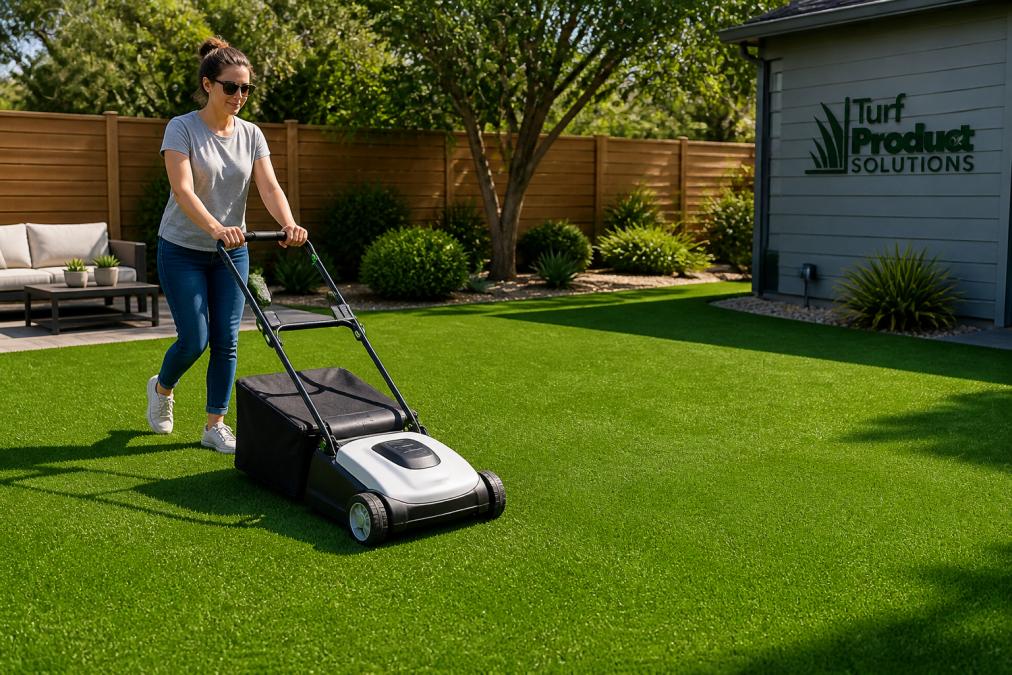
The best battery powered turf sweeper in 2026 is the Turf Power Sweep MAX, a 40V cordless system that sweeps and collects debris in a single pass. Its FiberLift nylon brush technology penetrates deep into synthetic fibers, lifting flattened blades and redistributing infill.
Turf Power Sweep MAX: The 40V Workhorse
The MAX runs on upgraded 5Ah batteries with a reinforced collection bag frame, gathering leaves, pet hair, dirt, and pine needles without a second raking pass. At $589.95, it replaces gas equipment entirely: no fumes, no pull cords, no engine maintenance.
Fiber Lift Pro: Precision Grooming for Edges and Tight Spaces
The Fiber Lift Pro ($289.95) carries a 17.3-inch nylon brush head and shares the MAX's 20V battery platform. It's the tool for fence lines, corners, and post-install finishing, where a full-width sweeper can't maneuver.
How to Remove Pet Odor from Artificial Grass (Without Harsh Chemicals)
Removing pet odor from artificial grass requires breaking down the uric acid crystals trapped in infill, not masking the smell. Live enzyme cleaners digest odor-causing bacteria at the source; fragranced products only cover it until the next rain.
Enzyme Cleaners That Actually Break Down Urine
Turf Animal Original is a plant-based enzyme concentrate with a pH-balanced formula that protects synthetic fibers. One gallon treats up to 8,000 square feet of heavy odor areas, free from sulfates, dyes, and synthetic perfumes. For larger properties, the Pro-Strength Eco Bag starter pack ($54.95) covers roughly 5,000 square feet with a hose-end applicator included.

Application Tips for Pet Zones and Dog Runs
Saturate the affected zone rather than misting, and let the product dwell so the enzymes can work. Rinsing immediately washes the formula past the contamination layer before it can digest anything.
Artificial Turf Cleaning Schedule: Weekly, Monthly, and Seasonal Tasks
A consistent artificial turf cleaning schedule prevents the slow buildup that turns fresh turf gray and matted. A consistent artificial turf cleaning schedule prevents the slow buildup that turns fresh turf gray and matted. Weekly debris removal, rinsing pet zones as needed, and brushing fibers against the grain every two to four weeks are generally recommended.
| Frequency | Task | Tool |
|---|---|---|
| Weekly | Remove leaves, pet hair, and surface debris | Turf Power Sweep MAX |
| As needed | Rinse pet zones and treat odors | Turf Animal enzyme cleaner |
| Every 2-4 weeks | Brush fibers against the grain | Fiber Lift Pro or turf rake |
| Seasonally | Deep clean, redistribute infill, check seams | Complete Turf Care Kit |
Manual Tools Worth Keeping: Rakes, Static Sweeps, and Hoses
Manual tools still earn their place for edges, tight corners, and fine debris a power sweeper scatters or can't reach. The mistake most homeowners make is buying one rake and using it everywhere: bristle stiffness has to match pile height, and getting that wrong does more damage than skipping the tool entirely.

Match Bristle Stiffness to Pile Height
Synthetic turf is sold by pile height, and fibers behave differently at each length. A tool that grooms a 1.75-inch putting green will flatten a 1.25-inch landscape lawn, and a soft brush safe on a 1-inch pet run won't lift matted blades on a 2-inch playground surface.
| Pile Height | Fiber Behavior | Bristle Type | Example Tool |
|---|---|---|---|
| Under 1.25 in (putting greens, pet runs) | Dense, low-loft, easily crushed | Soft nylon or silicone | Turf Static Sweep |
| 1.25-1.75 in (landscape lawns) | Standard loft, moderate matting | Medium nylon | Fiber Lift Pro |
| Over 1.75 in (playgrounds, high-traffic) | Tall fibers, prone to laying flat | Stiff nylon or polypropylene | Turf Power Sweep MAX on a deep setting |
Rakes: What to Buy and What to Avoid
A turf rake is not a leaf rake. Leaf rakes have thin, flexible tines designed to grab debris off soil; on synthetic turf they snag individual fibers and pull them out of the backing. Look for rounded plastic or silicone tines and a head width matched to your access, a 24-inch head suits open lawn, while a 15- to 18-inch head reaches fence lines and planters without scraping the backing.
Static Sweeps and Detail Brushes
The Turf Static Sweep ($26.95) uses high-friction silicone bristles that grip embedded pet hair and pollen without scattering it into the air, the right choice for fence lines, patio edges, and fire pits. For infill redistribution along edges, a stiff hand brush with a 4- to 6-inch head pushes infill back toward the center where a power sweeper can't reach.
Turf Power Sweep™ MAX + FREE Turf Power →
Hoses, Blowers, and Infill Management
A garden hose handles routine rinsing, and a leaf blower on low speed clears dry debris from hard-to-reach areas, but keep the nozzle at least 12 inches off the surface. A high-speed blower strips infill into your landscaping beds, meaning replacement infill within a season.
Tool Storage, Eco-Friendly Solutions, and Damage Troubleshooting
Storage and cleaning choices decide how long your equipment lasts, and almost no turf guide covers them. A $600 power sweeper with a clogged brush head or corroded battery terminal performs worse than a $27 static sweep. Here's how to store specialized tools, clean turf without commercial chemicals, and repair tools when they wear out.
Storing Turf Rakes, Brushes, and Power Equipment
The two enemies of turf tools are UV exposure and crushed bristles. Nylon and silicone bristles take a permanent set under load, so a rake leaned bristle-down against a wall will have flattened tines within a season.
- Hang, don't lean. Wall-mounted hooks or a simple rack keep bristles off the ground and out of contact with anything that presses them flat.
- Store power equipment indoors. Batteries lose capacity in temperature swings, and brush heads left in the sun become brittle. A garage shelf beats a shed.
- Keep batteries between 40% and 80% charge for long-term storage rather than fully drained or fully topped off. Most cordless platforms recommend a partial charge for anything sitting more than a month.
- Rinse enzyme sprayers after every use. Enzyme residue dries into a film that clogs nozzles and hose-end applicators. A 30-second flush with warm water prevents most of it.
- Cover collection bags. Debris left in a bag over winter breeds mold and stiffens the fabric, which tears at the seams the following spring.
Eco-Friendly Cleaning Solutions You Can Mix at Home
For pet owners who want to know exactly what's on their turf, a DIY approach is worth understanding. The goal is the same: break down uric acid crystals without degrading fibers or infill.
Troubleshooting Tool Damage
Tools wear out. Replacing them every season is expensive; maintaining them isn't.
- Power broom or sweeper brush heads. Nylon bristles flatten and lose lift after roughly 40-60 hours of use on abrasive infill. Most manufacturers sell replacement brush cartridges; swapping one takes 10-15 minutes with basic hand tools and costs a fraction of a new unit.
- Collection bag seams. The most common failure point is the seam where the bag meets the frame. Reinforce it with a strip of heavy-duty fabric tape before it tears, not after.
- Battery contacts. Corrosion on the terminals is the leading cause of "dead" cordless tools. A pencil eraser or a cotton swab with isopropyl alcohol clears it in most cases.
- Rake tines. Silicone tines that have taken a set can often be restored by soaking them in warm water for 10 minutes and hanging them to dry bristle-down.
- Hose-end applicators. Soak the screen and nozzle in warm water with a drop of dish soap for 15 minutes to dissolve enzyme and mineral buildup.
When to Repair vs. Replace
A simple rule: if the replacement part costs less than a third of a new tool and the tool is under five years old, repair it. Brush cartridges, bags, and batteries all qualify. If the motor housing is cracked, the battery platform is discontinued, or the frame is bent, replace it, parts availability dries up fast on discontinued cordless platforms.
Conclusion
Keeping artificial turf looking new comes down to using tools built for synthetic fibers instead of borrowing lawn equipment meant for soil and roots. Turf Product Solutions builds exactly that: the 40V Turf Power Sweep MAX with FiberLift nylon brush technology and a built-in collection bag, the compact Fiber Lift Pro for edges and tight spaces, and live enzyme Turf Animal cleaners that are safe for pets and families.
Frequently Asked Questions
What is the best tool for cleaning artificial turf?
A battery-powered turf sweeper like the Turf Power Sweep MAX handles most debris, pet hair, and fiber lifting in one pass. For edges and tight spaces, the Turf Static Sweep uses silicone bristles to grab fine debris without scattering it. Pair these with an enzyme cleaner for odors, and you cover every maintenance need without gas equipment or harsh chemicals.
How often should you power sweep artificial grass?
Brushing fibers against the grain every 2 to 4 weeks is generally recommended to keep turf upright and prevent matting. Weekly debris removal with a leaf blower or sweeper handles leaves and pet hair. For high-traffic pet areas, sweep more often, especially after heavy use or storms.
Are battery-powered turf sweepers worth the investment?
For homeowners with moderate to large turf areas, yes. The Turf Power Sweep MAX costs $589.95 and eliminates gas fumes, pull cords, and engine maintenance. It lifts flattened fibers, removes pet hair, and collects debris in one step. For small yards, the Fiber Lift Pro at $289.95 offers similar grooming power in a lighter package.
How do you remove pet odors from artificial turf effectively?
Use an enzyme-based cleaner that breaks down uric acid at the molecular level. Turf Animal uses plant-based enzymes and natural surfactants to digest odor-causing bacteria, not just mask the smell. One gallon treats up to 8,000 sq ft for heavy odor areas. Apply, let it dwell, then rinse. Repeat for stubborn spots.
What maintenance does artificial turf need seasonally?
Spring and fall call for deep cleaning: power sweep to lift matted fibers, redistribute infill, and remove embedded debris. Summer means rinsing pet zones more often and checking for weed growth along edges. Winter requires clearing leaves before they trap moisture. An artificial turf cleaning schedule with weekly, monthly, and seasonal tasks keeps turf looking new.