
Table of Contents
- 1. Remove Debris With the Right Tools Before Anything Else
- 2. How to Clean Artificial Grass With a Simple Water Rinse
- 3. Brush Fibers Upright to Restore Shape and Lift Matting
- 4. How to Remove Pet Urine Odor From Artificial Turf at the Source
- 5. Spot-Clean Spills and Stains Before They Set
- 6. Stop Weeds and Organic Matter From Taking Root
- 7. Artificial Turf Cleaning Tools and Safe Pressure-Washing Limits
- 8. How to Make Artificial Grass Look New Again With Deep Cleaning
- Frequently Asked Questions
Last Updated: October 4, 2026
1. Remove Debris With the Right Tools Before Anything Else
Dry debris removal is the first step in any routine to clean artificial turf, skip it and you push dirt deeper into the pile, so learn to clean artificial turf properly from the start.
A leaf blower handles light debris on dry turf in minutes. For heavier loads, a power broom does the job faster. The California Department of Toxic Substances Control technical document on PFAS in artificial turf notes that turf systems vary widely in construction, which is why brush depth settings matter on any powered tool.

Leaf Blowers vs. Power Brooms: What Works on Synthetic Turf
Leaf blowers suit quick touch-ups but scatter debris into flowerbeds and neighbors' yards. Power brooms lift matted fibers while sweeping, making them better for pet hair and embedded dirt.
2. How to Clean Artificial Grass With a Simple Water Rinse
A plain water rinse is the safest way to clean artificial grass between deeper sessions, flushing dust, pollen, and surface dirt through the backing without stressing the fibers.
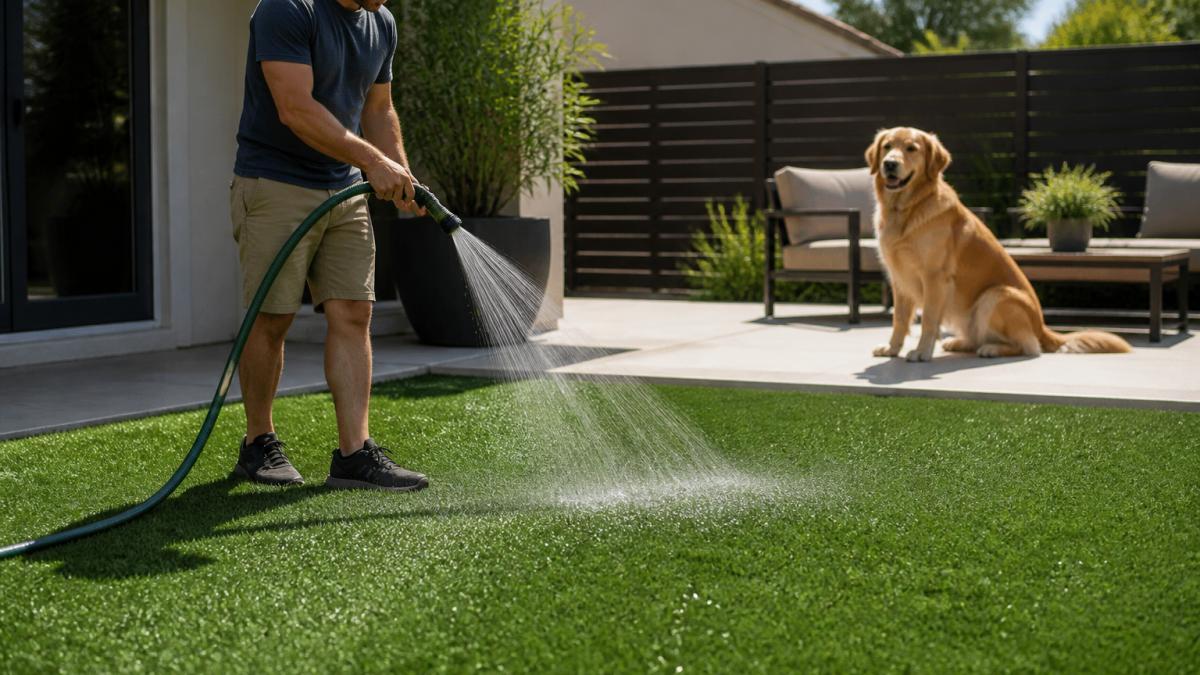
Rinse in sections, working with the slope so water drains toward the edges. Standing water usually means the base is compacted or the backing is clogged with fine dirt.
3. Brush Fibers Upright to Restore Shape and Lift Matting
Brushing separates turf that looks installed last month from turf that looks installed five years ago. Foot traffic crushes blades flat, and flattened fibers trap dust, hold moisture, and read as worn patches.
Cross brushing, working the brush in two directions at right angles, lifts the pile more effectively than pushing in a single line.
Cross Brushing Technique for High-Traffic Areas
Start at one edge and pull the brush toward you in straight lanes, then repeat at a 90-degree angle. On a dog run or a path between a patio and a gate, this two-pass approach restores bounce in one session.
The Turf Power Sweep MAX uses FiberLift nylon brush technology and five adjustable height settings, so you can set the depth for a putting green or a pet area without swapping equipment.
4. How to Remove Pet Urine Odor From Artificial Turf at the Source
Pet urine odor comes from bacteria digesting uric acid crystals trapped in the backing and infill, not the blades, which is why hosing the surface rarely fixes the smell for long. To remove pet urine odor from artificial turf, break down the crystals where they sit.
Enzyme cleaners do that work. Fragrance-based deodorizers only mask the smell, and the odor returns within days, especially in warm weather.

Why Enzyme Cleaners Beat Fragrance-Based Deodorizers
Plant-based enzyme formulas digest the organic waste that produces odor. Our Turf Animal Original uses a pH-balanced blend of plant-based enzymes and natural surfactants, free from sulfates, dyes, and synthetic perfumes. One gallon of concentrate treats up to 8,000 square feet in heavy odor areas.
| Product | Format | Coverage | Best For |
|---|---|---|---|
| Turf Animal Original (1 Gallon) | Concentrate, $44.96 | Up to 8,000 sq ft | Heavy odor areas, kennels |
| Turf Animal Original (3 Pack Quart) | 3 quarts + sprayers, $49.95 | 1,250 sq ft per quart | Homeowners, spot treatment |
| Turf Animal PRO STRENGTH Eco Bags | 84 oz starter pack, $54.95 | About 5,000 sq ft | Large yards, maintenance programs |
Apply when the turf is dry and the forecast is clear, watering first dilutes the enzymes before they reach the uric acid crystals.
5. Spot-Clean Spills and Stains Before They Set
Most stain advice stops at "blot and rinse," which works for water-based spills and fails for everything else. What determines whether a stain lifts or sets is the cleaner you choose and the stain's surface chemistry.
Match the Cleaner to the Stain
| Stain type | First move | Safe cleaner | Avoid |
|---|---|---|---|
| Coffee, soda, juice | Blot, then rinse | Warm water + a drop of mild dish soap | Bleach, ammonia |
| Grease, oil, sunscreen | Blot, then degrease | Diluted mild degreaser or dish soap | Solvents, acetone |
| Chewing gum | Freeze with ice, then lift | Nothing, mechanical removal only | Scraping with metal tools |
| Food dye, sports drink | Rinse immediately | Diluted mild soap, agitate with soft brush | Hot water (sets dye) |
| Paint, marker | Dab, do not spread | Isopropyl alcohol on a cloth, patch-tested | Pouring solvent directly on turf |
| Blood, pet accidents | Cold water first | Enzyme cleaner | Hot water, ammonia |
The Patch Test You Should Always Run First
Before any cleaner touches a visible area, test it on a hidden spot, under a step, behind a planter, or along a fence line. Apply, wait ten minutes, then rinse and let it dry. Check for:
- Color shift, some solvents dull the blade pigment permanently
- Fiber softening, a blade that feels gummy or limp after drying has been chemically attacked
- Backing separation, if the backing lifts at a seam, the cleaner is too aggressive
A patch test takes two minutes and prevents a repair that costs hundreds.
Products to Avoid on Any Synthetic Turf
- Bleach and chlorine, degrade backing adhesives and fade blade color
- Ammonia, attacks the UV stabilizers that keep fibers from going brittle
- Acetone, paint thinner, and most solvents, dissolve backing layers
Timing Matters More Than Technique
Act within the same day when possible, stains that sit through a hot afternoon bond to the blade surface, and heat accelerates dye absorption. For grease and oil, blot first; wiping spreads the stain.
If a stain survives two rounds of the correct cleaner, stop, repeated scrubbing does more damage than the stain. The issue is likely below the surface, in the backing or infill; the fix is a targeted enzyme treatment or a call to your installer.
6. Stop Weeds and Organic Matter From Taking Root
Weeds do not grow through healthy artificial turf. They grow in the organic layer on top of it, decomposed leaves, pollen, pet hair, and dust that form a seedbed. Remove that layer and you remove the weeds; miss it for a season and you are pulling weeds by hand every weekend.
(1 Gallon) Turf Animal ORIGINAL - Organic Artificial Turf Cleaner →
Where Weeds Actually Start
- Edges and borders, where turf meets soil, mulch, or concrete
- Seams, where two turf panels meet and debris collects in the gap
- Under fence lines, where a blower cannot reach and leaves pile up
Match Your Approach to Your Turf System
Not all turf is built the same, and the wrong weed treatment can damage the system you paid for.
- Infill type matters. Silica sand infill compacts and holds moisture, which encourages surface growth. Rubber infill drains faster but traps fine debris between granules. Zeolite and coated infills are more forgiving but should never be soaked with herbicide.
- Backing type matters. A perforated backing drains well and resists weed pressure. A solid backing traps moisture underneath, and any weed that reaches that layer is a sign of a base problem, not a surface one.
- Installation matters. Turf installed over a properly compacted aggregate base with a weed barrier has almost no weed pressure. Turf installed over bare soil will fight weeds for its entire life, no matter how often you clean it.
Seasonal Weed Pressure by Condition
- Spring pollen season, pollen settles into the pile and feeds surface growth. Rinse weekly during peak pollen.
- Summer heat, weeds germinate faster in warm, damp organic layers. Keep debris cleared and do not overwater.
- Fall leaf drop, the single biggest weed driver. Blow or sweep every few days during peak drop, not once at the end of the season.
Removal: Hand-Pull First, Spot-Treat Second
Pull weeds by hand while they are small and the root comes out clean. For persistent growth along borders and seams, a targeted spot treatment beats broadcasting herbicide, broadcast products can stain blades and leave residue that pets track indoors.
Never use a pre-emergent designed for soil on top of artificial turf. It does nothing for surface weeds and can damage the backing.
The Tool That Reaches What a Broom Cannot
The Turf Static Sweep reaches fence lines, curbs, and patio edges where a power broom cannot fit. Its silicone bristles lift embedded pet hair and fine debris without scattering it, the exact debris that becomes next season's weed bed.
When Cleaning Is Not Enough
If weeds return in the same spots after two full cleanings, the issue is the base or weed barrier, not the surface. An installer needs to inspect the sub-base, and catching it early saves a partial re-install.
7. Artificial Turf Cleaning Tools and Safe Pressure-Washing Limits
Pressure washing is the most misunderstood tool in turf care. Used correctly, it clears stubborn dirt from the backing. Used carelessly, it blasts infill out of the pile and tears seams apart.
Keep the pressure under 1,200 PSI, hold the nozzle at least 12 inches from the surface, and use a wide fan tip rather than a pinpoint stream.
What Pressure Washing Can and Cannot Do to Turf
Pressure washing removes caked dirt, pollen film, and dried spills, but it cannot fix odor, restore flattened fibers, or replace migrated infill, those jobs belong to enzyme cleaners and a power broom.
A complete artificial turf cleaning tools setup covers four jobs: debris removal, fiber lifting, odor treatment, and edge detailing. Our Complete Turf Care Kit bundles the Turf Power Sweep MAX, Turf Power Jet, Turf Animal Pro-Strength Starter Kit, and Turf Static Sweep for $669.95, less than most homeowners pay for two professional cleaning visits.

8. How to Make Artificial Grass Look New Again With Deep Cleaning
Deep cleaning restores appearance by addressing all four problems in sequence: debris, odor, matting, and infill. To make artificial grass look new again, run the full routine once per season rather than spot-fixing symptoms.
- Blow or sweep all loose debris off the surface
- Rinse the full area with a garden hose
- Apply enzyme cleaner to pet areas and high-traffic zones
- Cross brush the entire lawn to lift flattened fibers
- Check infill depth and top up low spots
- Detail edges, seams, and fence lines
Maintaining Infill Levels and Fiber Direction
Infill sits about half an inch below the blade tips on a healthy lawn. When it drops, fibers lean and the surface feels thin underfoot.
Fiber direction matters too. Brushing against the natural lean of the blades lifts them higher and keeps the lawn looking uniform from every angle.
Most turf problems trace back to one habit: reacting to visible mess instead of running a schedule.
Frequently Asked Questions
Can you use Dawn dish soap on artificial turf?
Dawn and other dish soaps can leave a slippery residue on synthetic turf and may strip the backing over time. They are not formulated for artificial grass and can attract dirt. Instead, use a pH-balanced cleaner designed for synthetic turf, like Turf Animal, which breaks down organic waste without leaving residue. If you must spot-clean with a mild soap, dilute it heavily and rinse thoroughly, but enzyme-based cleaners are safer for regular use and won't harm pets or degrade turf fibers.
Can you use a pressure washer on artificial grass?
You can use a pressure washer on artificial turf, but only at low pressure (under 1,200 PSI) and with a wide fan tip. High pressure can tear backing, displace infill, and fray fibers. Keep the nozzle at least 12 inches from the surface and never aim directly at seams or edges. For most cleaning, a garden hose rinse is enough. If you use a pressure washer, test a small area first and avoid blasting concentrated streams into the turf base.
How often should you clean artificial turf?
Light debris removal should happen weekly, especially during fall or after storms. A water rinse and brush pass every two to four weeks keeps fibers upright and infill distributed. Deep cleaning with an enzyme cleaner should happen monthly for pet areas and every two to three months for standard lawns. High-traffic commercial turf or kennels may need deep cleaning every two weeks. Adjust based on rainfall, pet use, and visible dirt buildup.
What cleaning products are safe for artificial turf?
Safe options include pH-neutral enzyme cleaners, diluted white vinegar for spot stains, and plain water for rinses. Avoid bleach, ammonia, harsh oxidizers, and quat-based disinfectants, which can degrade backing and harm pets. Products like Turf Animal use plant-based enzymes and natural surfactants to break down pet waste and odors without sulfates, dyes, or synthetic perfumes. Always check that a cleaner is labeled safe for synthetic grass and pet areas before applying it broadly.
Does vinegar harm artificial turf?
Diluted white vinegar (one part vinegar to four parts water) is safe for spot-cleaning artificial turf and can help with mild odors or stains. However, vinegar is acidic, and repeated undiluted use may weaken backing or fade color over time. Rinse the area thoroughly after applying. For persistent pet urine odor, enzyme cleaners are more effective because they digest the bacteria causing the smell rather than just masking it with acid.