
Table of Contents
- Is Artificial Grass Safe for Dogs? The Short Answer
- Heat Retention: Can Artificial Turf Burn Dog Paws?
- Chemical Safety: Lead, PFAS, and Toxic Leaching Risks
- How to Clean Artificial Grass for Dogs
- Artificial Grass Odor Removal That Actually Works
- Pet-Friendly Turf Infill and Drainage Systems
- Durability, Chewing, and Allergy Considerations
- Frequently Asked Questions
Last Updated: September 13, 2026
Is Artificial Grass Safe for Dogs? The Short Answer
Yes, artificial grass is safe for dogs, provided the turf is lead-free, PFAS-free, and paired with a drainage system that handles urine. The safety question isn't really about grass versus plastic. It's about which synthetic turf you buy and how you maintain it.
This guide from Turf Product Solutions covers the three risks that actually matter for dogs (heat, chemical leaching, and waste buildup), plus the cleaning protocols that keep a pet turf lawn hygienic year after year.

Artificial grass safe for dogs means three things: surface temperatures stay below paw-burn thresholds, the backing and infill contain no heavy metals, and waste never sits long enough to breed bacteria.
That last point is where most lawns fail. A 2025 case study comparing artificial turf and natural grass found that synthetic turf has a high potential to leach toxic metals including copper, zinc, cadmium, barium, manganese, and lead. The material matters. So does what you put on it.
Below, we break down the heat data, the chemical research, and the exact cleaning routine that separates a safe dog lawn from a smelly one.
What Makes Turf Safe or Unsafe
Three variables decide whether a turf lawn is safe for your dog:
- Material composition. Polyethylene blades with a polyurethane or porous backing are the baseline. Lead-free and PFAS-free formulations are now the standard for quality pet turf.
- Infill type. Silica sand, zeolite, or antimicrobial infills manage moisture. Crumb rubber does not belong on a pet lawn.
- Drainage and maintenance. A perforated backing plus a compacted sub-base moves urine through the surface instead of letting it pool.
Get all three right and the lawn performs for a decade. Miss the drainage layer and you'll be fighting odor within months.
Heat Retention: Can Artificial Turf Burn Dog Paws?
Yes. Synthetic turf runs significantly hotter than natural grass in direct sun, and that's the most immediate physical risk to dogs.
A 2026 study on dog preference between artificial and natural turf found that artificial turf surfaces reach significantly higher temperatures than natural surfaces, increasing the risk of discomfort and potential injury to dogs. On a 90°F day, a synthetic surface can climb well past 130°F, hot enough to damage paw pads in seconds.
What most guides miss is that heat retention depends on infill and color. Light-colored, silica-infilled turf stays measurably cooler than black crumb rubber. Watering the lawn before playtime drops surface temperature temporarily, but the effect fades fast in full sun.
A practical rule: if you can't hold your palm on the turf for five seconds, your dog shouldn't be walking on it.
Chemical Safety: Lead, PFAS, and Toxic Leaching Risks
Chemical safety comes down to three things: what the turf is made of, what's been spread on it, and whether anyone independent has verified the claims. Most guides stop at the first one.
Older or cheap synthetic turf sometimes contains lead-based pigments and PFAS compounds used for stain and water resistance. The regulatory picture has tightened considerably. The Consumer Product Safety Commission enforces a 100 ppm total lead limit on children's products, and several states, including California, New York, and Washington, have enacted PFAS restrictions on consumer goods that increasingly sweep in synthetic turf. Modern pet-friendly turf is marketed as 100% lead-free and PFAS-free specifically to address these toxicity concerns, per [Magnolia Turf's 2026 pet turf(/blogs/news/how-to-deep-clean-pet-turf) assessment | magnoliaturf.com].
The leaching research is more nuanced than marketing suggests. Leaching rates depend heavily on pH, age, and rainfall. Newer polyethylene products with non-toxic pigments show far lower risk than aged crumb-rubber installations. The mechanism matters: crumb rubber is a recycled tire product, and tires are formulated with zinc, polycyclic aromatic hydrocarbons, and other compounds that migrate more readily as the material weathers and breaks down. Polyethylene blades with a polyurethane backing don't carry that same load.
What should you check before buying?
- Backing material: porous polyurethane or woven fabric, not solid rubber
- Infill: silica sand, zeolite, or coated antimicrobial sand, never crumb rubber on a pet lawn
- Certifications: look for lead-free and PFAS-free claims backed by third-party lab testing, not just a marketing badge. Ask which lab and which test method.
- Documentation: request the material safety data sheet (SDS) and any independent test reports
If you're installing over an existing lawn, ask for the SDS before you sign. A reputable installer will hand it over without hesitation. An installer who deflects is telling you something.
One gap most articles miss: the leaching risk isn't static. It changes with the age of the turf and the chemistry of what lands on it. Dog urine is acidic, and repeated exposure to acidic waste can accelerate the breakdown of pigments and backing over years. That's another argument for the enzyme cleaning routine below, it's not just about odor, it's about slowing material degradation that could eventually release compounds you don't want under your dog's paws.
How to Clean Artificial Grass for Dogs
Cleaning artificial grass for dogs means removing solid waste immediately, flushing the area with water, and applying an enzymatic cleaner that breaks down uric acid rather than masking it.
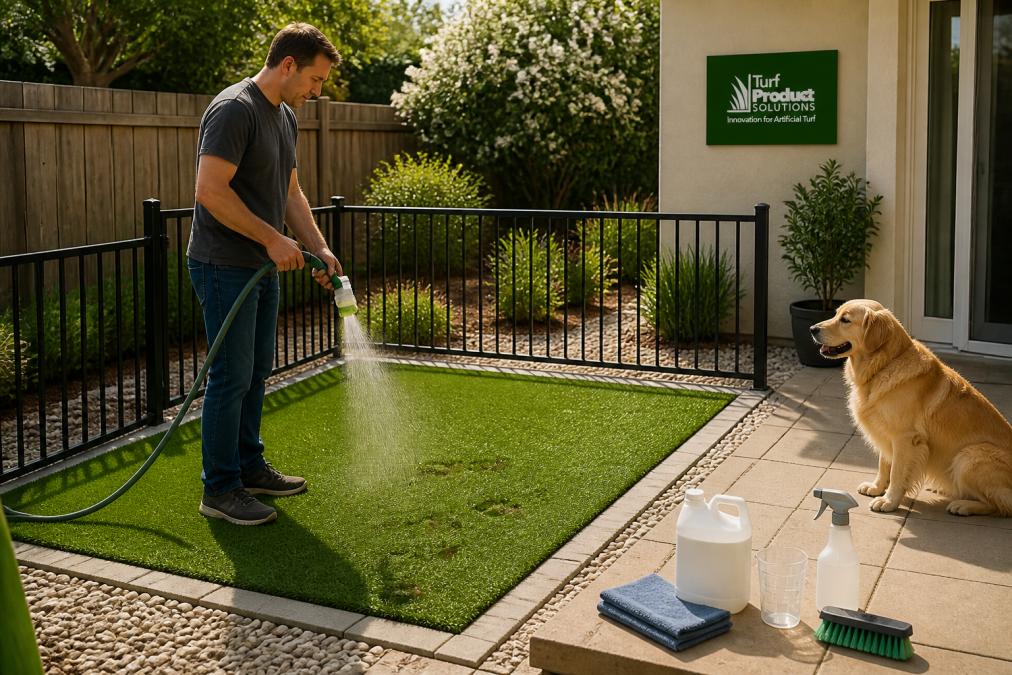
Hosing alone doesn't work. Uric acid crystals bind to the backing and blades, and water just pushes them deeper. That's why a lawn that smells clean after rinsing smells like ammonia two days later.
Daily and Weekly Cleaning Routine
A simple schedule keeps odor from ever taking hold:
| Frequency | Task | Tool |
|---|---|---|
| Daily | Remove solid waste | Bag and dispose |
| Daily | Rinse urine spots | Hose or watering can |
| Weekly | Apply enzyme cleaner | Hose-end sprayer |
| Monthly | Deep clean high-traffic zones | Concentrated enzyme solution |
| Seasonally | Brush up matted blades | Power broom |
For most single-dog households, that's fifteen minutes a week. Skip the weekly enzyme step and you'll spend triple that time correcting odor later.
Cleaning Protocols for Multi-Pet Households
Two or more dogs changes the math. Urine volume doubles or triples, and the same spot gets hit repeatedly.
Multi-pet lawns need:
- Twice-weekly enzyme treatments on the primary elimination zones
- Rotation of potty areas if your yard allows it, so no single patch gets saturated
- A concentrated formula diluted to label strength, not a ready-to-use spray
Turf Product Solutions' Turf Animal Original is a plant-based live enzyme concentrate built for this exact scenario. It breaks down urine, organic waste, and bacteria at the source instead of covering the smell. One gallon of concentrate at $44.96 covers roughly 1,000 square feet per application when diluted, which makes it practical for kennels and multi-dog homes alike.

Artificial Grass Odor Removal That Actually Works
Odor removal works when you attack the source, not the symptom. Enzymatic cleaners digest the uric acid crystals that produce ammonia smell. Masking agents and bleach don't.
Here's the sequence that works:
- Pick up solids immediately.
- Rinse the area thoroughly with water.
- Apply a live enzyme cleaner at the dilution on the label.
- Let it dwell for the full contact time before rinsing again.
- Brush the blades upright so air reaches the backing.
The dwell time step is where people cut corners. Enzymes need time to break the crystal bonds. Spray and immediate rinse does almost nothing.
For a deeper look at how odor-causing bacteria behave on synthetic surfaces, the 2026 pet turf safety overview from Verdi Grass covers the maintenance side in detail.
Turf Product Solutions' PRO STRENGTH Outdoor Odor Remover, sold as a starter pack with a sprayer for $54.95, uses the same live enzyme formula in eco-bag packaging. It's the more economical route if you're treating a large area regularly or running a commercial facility.
Pet-Friendly Turf Infill and Drainage Systems
Pet-friendly turf infill and drainage decide whether your lawn stays hygienic under daily use. Infill sits between the blades and manages moisture, shock absorption, and odor. Drainage moves liquid off the surface before it pools.
The best options for dog lawns:
- Zeolite infill: traps ammonia molecules and releases them slowly, reducing odor between cleanings
- Silica sand: inexpensive, drains well, but offers no odor control
- Antimicrobial coated sand: adds a bacteria-inhibiting layer, useful for kennels
Under the turf, you need a compacted aggregate sub-base and a perforated or porous backing. Urine permeability is the spec that matters. A solid rubber backing traps waste against the subsurface, and no amount of cleaning fixes that.
Durability, Chewing, and Allergy Considerations
Durability is where quality turf earns its price. A well-installed polyethylene lawn with UV stabilization handles daily dog traffic for 10-15 years. Chewers and diggers are the exception, and they're the reason some installations fail in year two instead of year twelve.
Chewing and Digging
Dogs that chew turf can pull up seams and ingest fibers. The failure mode is usually mechanical, not chemical: a lifted seam becomes a flap, the flap becomes a chew toy, and the backing separates from the sub-base. For those dogs, a higher pile height with a firm backing and a secured perimeter helps, but supervision is the real fix. No turf is chew-proof.
Digging is a different problem. Dogs dig at turf for the same reasons they dig at sod, boredom, prey drive, or a cool spot to lie down. A turf lawn doesn't eliminate the behavior, and once a dog excavates through the infill and backing, repair means cutting and patching, not raking. If your dog is a committed digger, plan for a designated digging zone with loose material rather than fighting the instinct across the whole lawn.
Allergy Management: The Underrated Angle
Synthetic turf is hypoallergenic by nature: no pollen, no grass mites, no seasonal allergens. For dogs with grass allergies, a turf lawn often reduces itching and paw licking within weeks. That's the pitch, and it's largely true.
What most guides miss is that turf allergies usually come from buildup, not the turf itself. Pollen, mold, and bacteria accumulate on an unwashed lawn, and a dog with environmental sensitivities can react to that load just as readily as to a natural lawn. A regular enzyme cleaning routine removes the allergen load along with the odor. The turf isn't the allergen, the film on top of it is.
There's a second, less-discussed trade-off. Natural grass provides a microbial environment that some veterinarians believe supports a dog's immune development, particularly in puppies. Synthetic turf is inert by comparison. The research here is early and not settled, so treat it as a consideration rather than a verdict, but if you're choosing turf specifically for a puppy with allergy concerns, it's worth raising with your vet.
Climate Changes the Calculus
Durability and allergy performance both shift with where you live, and almost no guide addresses this.
- High-humidity climates: turf dries slowly, mold and mildew pressure is higher, and odor-causing bacteria thrive between cleanings. Enzyme treatment frequency needs to increase, and drainage design matters more.
- Arid climates: turf dries fast, which suppresses mold, but surface temperatures run higher and UV degradation is faster. Shade structures and more frequent watering before playtime become durability tools, not just comfort tools.
- Freeze-thaw regions: the sub-base is the weak point. Improperly compacted aggregate heaves, and heaving opens seams that chewing dogs then exploit.
If your installer quotes the same spec for every yard regardless of climate, ask why. The right answer involves your local rainfall, humidity, and temperature swing, not a one-size-fits-all product sheet.
For a broader look at how turf fits into low-maintenance lawn replacement, the 2026 artificial grass guide from Superior Lawn covers installation and care fundamentals.
Frequently Asked Questions
Can dogs pee and poop on artificial turf grass?
Yes, dogs can use artificial turf for bathroom breaks, but urine and feces require regular cleanup to prevent odor and bacteria buildup. Solid waste should be removed immediately, and urine needs rinsing or an enzymatic cleaner. Without proper maintenance, waste can accumulate in the infill and backing, leading to persistent smells and potential hygiene issues for pets and families.
Does artificial grass get too hot for dog paws?
Artificial turf can reach significantly higher surface temperatures than natural grass, especially in direct sunlight, according to a 2026 PMC study on dog preference between artificial and natural turf. This heat retention raises the risk of paw burns and discomfort. To reduce risk, water the turf before play, provide shaded areas, and avoid using it during peak afternoon heat.
What are the negatives of artificial turf for pets?
Key negatives include heat retention that can burn paws, potential chemical leaching of heavy metals like lead and cadmium, and odor buildup if waste isn't managed. Some dogs may chew or dig at the turf, causing damage. Choosing PFAS-free, lead-free products and following a consistent cleaning routine with pet-safe enzymatic cleaners can address most of these concerns.
How do you clean artificial grass to keep it safe for dogs?
Remove solid waste daily, rinse urine spots with water, and apply a pet-safe enzymatic cleaner weekly to break down odors at the source. For multi-pet households, increase frequency to two or three times per week. Use a hose-end sprayer for large areas and a trigger sprayer for spot treatments. Products like Turf Animal Original are formulated to Whole Foods eco-ingredient standards and are safe for pets and families.