
Table of Contents
- Why Artificial Turf Needs Regular Cleaning for Pet Owners
- Quick Comparison: Top Pet-Safe Sanitizing Solutions
- 1. Turf Animal: Live Enzyme Cleaner for Deep Odor Elimination
- 2. Enzymatic Cleaners: How They Break Down Uric Acid
- Best Artificial Grass Cleaner for Dog Urine: What Works
- How to Remove Dog Smell from Artificial Grass: Step-by-Step
- Artificial Grass Maintenance Schedule for Pet Owners
- DIY vs. Commercial Solutions: Pros, Cons, and Safety
Last Updated: August 12, 2026
Why Artificial Turf Needs Regular Cleaning for Pet Owners
Pet owners with artificial turf face a challenge that natural grass doesn't: odors and bacteria concentrate in the infill and fiber layers where traditional rinsing can't reach. When dogs use artificial turf regularly, urine doesn't drain away like it does in soil. Instead, uric acid crystals accumulate in the turf system, creating persistent odors that worsen over time and attract repeated marking behavior. This is where pet safe artificial turf sanitizing solutions become essential.
Basic water rinses address surface debris but miss the root cause. Homeowners who switch from simple hosing to enzyme-based cleaning see dramatic improvements in odor control and turf longevity. Enzymatic cleaners break down uric acid at the molecular level while targeting odor-causing bacteria that multiply in moist infill environments. Regular sanitization also protects the turf material itself by preventing degradation of synthetic fibers and extending your investment's lifespan.
Quick Comparison: Top Pet-Safe Sanitizing Solutions
Solution Type |
Best For |
Application Method |
Key Benefit |
|---|---|---|---|
Live enzyme cleaners |
Deep odor elimination |
Spray and dwell |
Breaks down uric acid crystals |
Enzymatic powder concentrates |
Budget-conscious owners |
Mix with water |
Economical per gallon |
Zeolite infill |
Long-term prevention |
Top layer application |
Absorbs ammonia for years |
Sanitizing systems |
Commercial facilities |
Hose-end sprayer |
Kills bacteria while cleaning |
DIY vinegar solutions |
Light spot treatment |
Spray directly |
Immediate odor masking |
1. Turf Animal: Live Enzyme Cleaner for Deep Odor Elimination
Turf Animal uses live enzyme technology specifically formulated to penetrate infill layers and eliminate uric acid at the source. Unlike surface-level cleaners, the live enzymes continue working after application, breaking down organic compounds that cause persistent dog urine odors.

The formula is safe for pets and families, with no harsh chemicals or ammonia-based ingredients that damage synthetic fibers. Many pet owners report that one application significantly reduces odors, and regular use prevents them from returning. The concentrate format means you're not paying for water weight; a gallon covers substantial square footage when properly diluted.
The 1-gallon concentrate at $44.96 works well for smaller to medium yards, while the 2-pack at $83.93 suits larger areas. For professional landscapers, the eco-bag refill system at $49.95 (2-pack) or $94.95 (4-pack) offers commercial-scale economics.

2. Enzymatic Cleaners: How They Break Down Uric Acid
Enzymatic cleaners work through a biological process fundamentally different from chemical disinfectants. Enzymes are proteins that catalyze specific chemical reactions, breaking the molecular bonds in uric acid crystals and other organic compounds that cause odors.
When urine contacts artificial turf, uric acid crystallizes in the infill and lower fiber layers, creating a reservoir of odor-causing compounds. Enzymatic cleaners contain proteases and specialized enzymes that target these crystals directly, converting them into harmless byproducts. This is why enzymatic solutions eliminate odors rather than masking them with fragrance.
Effectiveness depends on dwell time, the period the solution remains wet on the turf. Most enzyme-based products require 15-30 minutes of contact time. Temperature also matters: enzymes function optimally between 50°F and 100°F. A common approach is to apply the solution in the evening and allow it to work overnight, then rinse thoroughly the next morning.
Best Artificial Grass Cleaner for Dog Urine: What Works
The best artificial grass cleaner for dog urine combines enzymatic action with safety for pets and fiber integrity. Products using live enzyme technology outperform chemical-only solutions because they address the root cause rather than masking symptoms.
Key characteristics include: enzymes specifically targeting uric acid, non-toxic formulations safe for repeated pet contact, concentrated formulas reducing water usage and packaging waste, and compatibility with all synthetic turf types.
For deeper penetration and longer-lasting results, professional-grade enzyme concentrates like Turf Animal dissolve urine crystals rather than just surfacing the odor, making them ideal for yards with persistent problems.
How to Remove Dog Smell from Artificial Grass: Step-by-Step
Removing established dog odors from artificial turf requires a systematic approach addressing both surface contamination and deep infill saturation.
Step 1: Initial Inspection and Surface Cleanup Identify areas with the strongest odor and remove any solid debris, fallen leaves, or organic matter using a rake or turf broom.
Step 2: Spot Test Test your chosen cleaner on a small, inconspicuous area to confirm it won't discolor the turf.
Step 3: Prepare the Solution If using a concentrate, mix according to package directions. Most enzyme concentrates dilute to 1:10 or 1:20 ratios depending on odor severity.
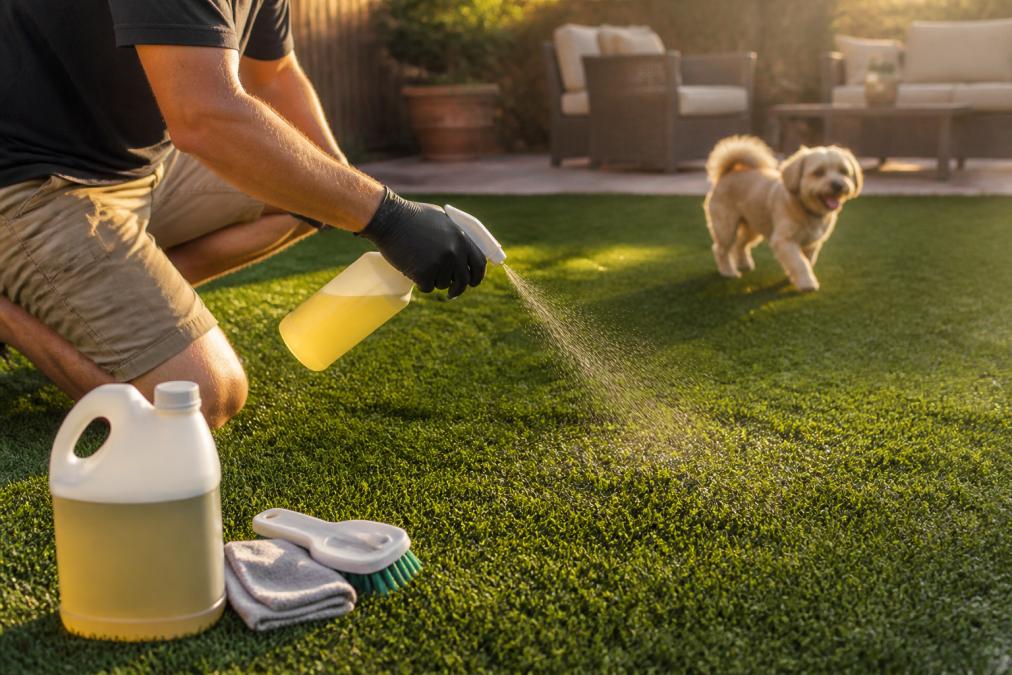
Step 4: Apply with Even Coverage Use a pump sprayer, hose-end sprayer, or backpack sprayer to apply the enzymatic solution evenly across affected areas, saturating the turf without creating puddles.
Step 5: Allow Dwell Time Let the solution sit for 15-30 minutes (or longer for aged odors). Keep pets off the treated area during this period.
Step 6: Rinse Thoroughly Use a hose to rinse the treated area thoroughly with clean water until the water runs clear.
Step 7: Allow Drying Let the turf dry completely before allowing pets back on the treated area, typically 2-4 hours depending on temperature and humidity.
For severe, long-standing odors, repeat this process weekly for 3-4 weeks to fully eliminate accumulated uric acid crystals.
Artificial Grass Maintenance Schedule for Pet Owners
A consistent maintenance schedule prevents odor problems from developing. Pet owners should approach artificial grass maintenance differently than those without animals.
Weekly Maintenance Remove solid waste and debris daily using a turf broom or rake. This prevents organic matter from decomposing in the infill and creating odor sources.
Bi-Weekly Spot Treatment Spray high-traffic areas with diluted enzymatic cleaner. This preventive approach prevents uric acid from accumulating to problematic levels.
Monthly Deep Cleaning Perform a full-yard treatment with your chosen pet safe artificial turf sanitizing solution at full strength, allow proper dwell time, and rinse thoroughly.
Quarterly Infill Inspection Examine the infill layer in high-use areas. If it appears compacted, contaminated, or matted, it may need professional-grade cleaning or infill replacement.
Annual Professional Service Consider professional deep cleaning once yearly, especially with multiple pets or concentrated use. Professional equipment reaches deeper into the infill system than homeowner tools.

Frequency |
Task |
Time Required |
Tools Needed |
|---|---|---|---|
Daily |
Remove solid waste |
5 minutes |
Rake or shovel |
Weekly |
Debris removal and surface sweep |
15-20 minutes |
Turf broom |
Bi-weekly |
Spot treat high-traffic areas |
10 minutes |
Spray bottle, enzyme solution |
Monthly |
Full-yard enzymatic cleaning |
30-45 minutes |
Pump sprayer, hose, enzyme cleaner |
Quarterly |
Infill inspection and assessment |
15 minutes |
Visual inspection only |
Annually |
Professional deep cleaning |
Professional service |
Commercial equipment |
Consistency matters more than intensity. Regular maintenance keeps bacterial populations in check and prevents uric acid crystallization.
DIY vs. Commercial Solutions: Pros, Cons, and Safety
DIY Vinegar-Water Solutions
A vinegar-water mixture (typically 1:1 ratio) is the most common DIY approach. Vinegar's acidity temporarily neutralizes ammonia odors, providing immediate but temporary relief at minimal cost.
The limitations are substantial. Vinegar masks odors rather than eliminating them; underlying uric acid crystals remain in the infill. The smell returns within days or weeks, and vinegar doesn't address odor-causing bacteria. Additionally, acidity can potentially affect turf color over time with repeated heavy applications.
DIY Baking Soda Treatments
Baking soda absorbs odors and is safe for pets. However, it doesn't penetrate infill layers and won't address established urine saturation. It's best used as a maintenance supplement rather than a primary solution.
Commercial Enzymatic Products
Commercial enzyme cleaners offer targeted action that DIY solutions cannot match. Enzymes are specifically formulated to break down uric acid and organic compounds. Concentrated products provide better economy than ready-to-use sprays and are tested for safety around pets.
The trade-off is higher upfront cost, though the concentrate format often makes the cost per treatment comparable to or lower than repeated DIY applications when factoring in superior results.
Sanitizing Systems
Sanitizing systems can kill odor-causing bacteria while cleaning, providing sanitization benefits beyond odor elimination.
Safety Considerations
Avoid products containing bleach or ammonia, which can damage synthetic fibers and create toxic fumes when mixed with other cleaners. Never use products designed for natural grass on artificial turf. Always check that any product is explicitly labeled as safe for artificial turf and pets.
Pet safe artificial turf sanitizing solutions should never contain harmful chemicals like phenol, formaldehyde, or strong surfactants that accumulate in infill. Read ingredient lists carefully and contact manufacturers when in doubt.
Keeping artificial turf fresh and odor-free when pets use it regularly requires commitment to a cleaning schedule and the right tools. The enzymatic approach, whether through live enzyme cleaners like Turf Animal from Turf Product Solutions or other professional-grade solutions, addresses the root causes of odor rather than masking symptoms. For homeowners managing pet-safe artificial turf sanitizing challenges, starting with a quality enzyme concentrate and maintaining a monthly schedule prevents most problems before they develop. The investment in proper cleaning solutions and equipment pays for itself through extended turf lifespan and the comfort of a yard that stays fresh despite heavy pet use.
Frequently Asked Questions
What is the best pet-safe deodorizer for artificial grass?
Enzymatic cleaners like Turf Animal are among the most effective pet-safe deodorizers because they use live enzymes to break down uric acid and organic waste at the source rather than masking odors. Look for products formulated specifically for artificial turf that are non-toxic and biodegradable. Turf Animal Original starts at $44.96 per gallon and targets the bacterial microbes causing odors, making it safe for dogs and families while delivering professional-grade results.
How often should you sanitize artificial turf with pets?
Most pet owners should sanitize artificial turf every 2-4 weeks for light use, or weekly for high-traffic dog runs and commercial facilities. Spot treatment after accidents should happen immediately to prevent uric acid from penetrating the infill. In areas with heavy pet use, a deep cleaning every 6-8 weeks using enzymatic cleaners helps prevent odor-causing bacteria from building up and maintains long-term fiber integrity.
Are enzyme cleaners effective for pet urine on turf?
Yes, enzyme cleaners are highly effective because they contain bacterial microbes that actively digest urine compounds, particularly uric acid crystals that cause persistent odors. Unlike ammonia or bleach, which can damage synthetic grass fibers, enzymatic cleaners work safely within the turf system. The live enzymes in products like Turf Animal penetrate the infill layers to eliminate odors at the source, not just on the surface.
Can I use vinegar to clean artificial turf?
Vinegar can work as a temporary odor neutralizer and is pet-safe, but it's not as effective as enzymatic cleaners for breaking down uric acid. A vinegar-water solution (1:1 ratio) can help with light odors and surface contamination, but it won't eliminate bacteria causing persistent smells. For stubborn dog urine odors, enzymatic cleaners designed for artificial turf deliver better results and longer-lasting sanitation than vinegar alone.
This article was written using GrandRanker