
Table of Contents
- Why Buying Artificial Turf Cleaning Solution Online Beats Store Runs
- Pet Safe Artificial Grass Cleaner: What to Look For Before You Buy
- How to Remove Dog Urine Smell from Artificial Turf
- Artificial Turf Maintenance Tools That Make Cleaning Easier
- Pricing Guide: What You'll Pay When You Buy Artificial Turf Cleaning Solution Online
- Environmental Impact and Long-Term Turf Longevity
- Frequently Asked Questions
- Conclusion
Last Updated: September 22, 2026
Why Buying Artificial Turf Cleaning Solution Online Beats Store Runs
When you need to buy artificial turf cleaning solution online, the selection beats anything a hardware store shelf can offer. Big-box retailers typically stock one or two general-purpose cleaners, while online turf cleaning solution suppliers carry concentrated, enzyme-based formulas built specifically for synthetic grass, pet odors, and infill.
This guide from Turf Product Solutions breaks down exactly what to buy, what it costs, and how to use it. The numbers explain why homeowners are switching: the global artificial grass cleaner market hit US$1,098 million in 2025 and is projected to reach US$1,746 million by 2034, according to 24 Market Reports' turf cleaner market analysis.
The math gets sharper when you compare replacement costs. Replacing a 1,000-square-foot yard runs $5,000 to $20,000, while professional cleaning services cost about $2,000 annually (TurFresh's artificial turf cleaning cost guide).
Online buying also means you get the concentrated versions that stores rarely stock.
Pet Safe Artificial Grass Cleaner: What to Look For Before You Buy
A pet safe artificial grass cleaner has to do two jobs at once: break down urine at the molecular level and stay compatible with the backing, fibers, and infill it touches. Miss either one and you either get a lingering ammonia smell or a turf that stiffens, fades, and sheds infill within a couple of seasons.
A practical label checklist before you buy:
- Live enzymes or bacteria listed by name, not just "enzymatic" on the front panel.
- pH between roughly 6 and 8. Neutral-to-slightly-alkaline formulas are gentle on polyethylene and nylon blades.
- No bleach, no quaternary ammonium compounds (quats), no hydrogen peroxide in the primary actives.
- No unnamed "fragrance." If scent is doing the work, enzymes aren't.
- Sulfate-free and dye-free if you have dogs that chew or roll on the turf.
Material Compatibility: Matching Cleaner to Backing, Fiber, and Infill
| Turf Component | Common Materials | What Harms It | What's Safe |
|---|---|---|---|
| Blades | Polyethylene, nylon, polypropylene | Bleach, high-pH degreasers, solvents | pH-balanced enzyme formulas |
| Primary backing | Woven polypropylene, polyester | Strong oxidizers, prolonged acid exposure | Diluted enzyme cleaners |
| Secondary backing | Polyurethane or latex | Petroleum solvents, high-heat rinses | Water-based, sulfate-free cleaners |
| Infill | Silica sand, coated rubber, zeolite | Bleach (degrades rubber coating), oily surfactants | Enzyme cleaners, plain water rinse |
One more compatibility note: sun-exposed turf can already run about 37 °F hotter than asphalt ([MDPI's artificial turf(/blogs/news/how-to-remove-dog-urine-smell-from-artificial-turf) heat study | mdpi.com]). Heat stress weakens fibers on its own, so adding a harsh chemical on top of that accelerates breakdown. A pH-balanced enzyme cleaner is the low-stress option for turf that already bakes in summer.
How to Remove Dog Urine Smell from Artificial Turf
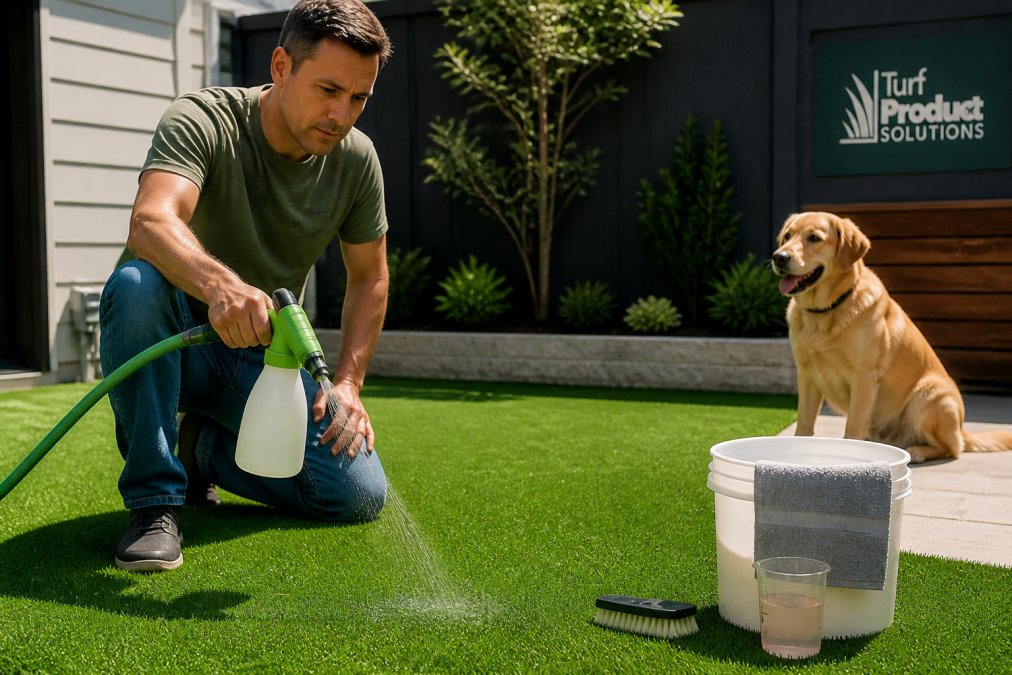
To remove dog urine smell from artificial turf, soak the affected area with a diluted enzyme cleaner, let it dwell for 10 to 15 minutes, scrub the fibers, and rinse thoroughly. Repeat weekly for heavy-use zones until the ammonia smell is gone.
Step-by-Step: Soaking, Scrubbing, and Rinsing
- Pick up solids and hose off loose debris.
- Mix your cleaner at the label ratio. Turf Animal's 1-gallon concentrate treats up to 8,000 sq ft for heavy odor areas.
- Soak the area until the infill is saturated.
- Scrub with a stiff brush to lift matted fibers and work the solution down.
- Let it dwell 10 to 15 minutes so enzymes can digest urine crystals.
- Rinse thoroughly with a hose-end sprayer.
- Repeat weekly in high-traffic zones.
Concentrated formulas like Turf Animal Original ($44.96) use plant-based enzymes and natural surfactants to digest odor-causing bacteria instead of masking it.

Artificial Turf Maintenance Tools That Make Cleaning Easier
The right turf maintenance tools cut cleaning time in half and protect fiber integrity. A corded or battery-powered sweeper, a hose-end sprayer, and a stiff-bristle brush cover 90% of routine jobs.
| Tool | Job | Frequency | Best For |
|---|---|---|---|
| Battery sweeper | Lift fibers, clear debris | Weekly | All turf sizes |
| Hose-end sprayer | Apply enzyme cleaner | Weekly to monthly | Odor zones |
| Stiff brush | Scrub matted areas | As needed | Pet runs |
| Trigger sprayer | Spot-treat stains | As needed | Small patches |
Pricing Guide: What You'll Pay When You Buy Artificial Turf Cleaning Solution Online
Most pet-safe turf cleaning solution formulas fall in the $20 to $50 range, according to EverTurf's 2026 pet-safe cleaner guide. Concentrates stretch further, so cost-per-square-foot drops fast.
Here is what Turf Product Solutions charges:
| Product | Price | Coverage |
|---|---|---|
| Turf Animal Original, 1 Gallon | $44.96 | Up to 8,000 sq ft |
| Turf Animal Original, 3-Pack Quart | $49.95 | 3,750 sq ft |
| Turf Animal PRO Starter Pack | $54.95 | 5,000 sq ft |
| Turf Animal PRO 4-Pack Refill | $94.95 | 9,000 sq ft |
Environmental Impact and Long-Term Turf Longevity
Most turf cleaning guides stop at "use eco-friendly products" and never explain where the rinse water goes or what chemistry does to turf over a decade. Those are the two questions that actually separate a cleaner that protects your investment from one that quietly shortens it. Understanding the long-term interaction between synthetic fibers and chemical runoff reveals why prioritizing eco friendly cleaning products remains the most effective way to preserve the structural integrity of your lawn.


Where the Runoff Actually Goes
When you rinse a treated turf area, the water does not vanish. It either percolates into the soil beneath the turf base or runs off the edge of the installation toward a driveway, sidewalk, or storm drain. In most residential installations, storm drains discharge directly to local creeks, rivers, or retention ponds without treatment, the same waterways that feed groundwater and irrigation supplies.
- Bleach and peroxide break down into chloride and oxygen byproducts that can stress aquatic life at concentrated levels.
- Quaternary ammonium compounds (quats) are persistent surfactants that bind to soil and sediment and are slow to biodegrade.
- Synthetic fragrance and dye are largely cosmetic and add unnecessary chemical load to runoff.
- Enzymatic, biodegradable formulas break down into carbon dioxide, water, and simple organic compounds as the bacteria consume the waste they were applied to.
How Chemistry Affects Turf Longevity
Turf longevity is a chemistry story as much as a wear story. The two failure modes that show up first on a chemically stressed lawn are UV degradation and fiber embrittlement.
- UV degradation: Polyethylene and nylon blades are stabilized with UV inhibitors blended into the polymer. Harsh oxidizers, high-pH degreasers, and solvent-based cleaners can strip or break down those stabilizers at the surface, which accelerates fading, chalking, and brittleness. A pH-balanced cleaner leaves the UV package intact.
- Fiber embrittlement: Repeated exposure to bleach or high-pH formulas draws plasticizers out of the polymer over time. Blades lose flexibility, snap instead of bending, and mat down faster under foot traffic.
- Backing delamination: Latex-backed turf is especially vulnerable. Oxidizers and high-pH cleaners attack the latex bond, and once tufts start lifting, the turf is on a path to replacement.
- Infill breakdown: Coated rubber crumb degrades faster under bleach, releasing fines that compact and reduce drainage. Silica sand and zeolite hold up better.
Frequently Asked Questions
What is the best product to clean artificial turf?
The best product depends on your main problem. For pet odors, an enzymatic cleaner like Turf Animal breaks down urine crystals and bacteria at the source instead of masking the smell. For general debris, a battery-powered sweeper lifts fibers and removes organic waste. Turf Animal Original is pH-balanced, free from sulfates and synthetic dyes, and safe for pets and kids. One gallon treats up to 8,000 sq ft for heavy odor areas.
How can I remove the smell of dog urine from my artificial turf?
Start by soaking the affected area with water to dilute urine salts, then apply a live enzyme cleaner like Turf Animal. The enzymes digest the odor-causing bacteria and ammonia crystals trapped in the infill. Let it sit for the recommended time, scrub with a stiff brush, and rinse. Repeat for heavily saturated spots. Most pet owners see results after one or two applications. Consistent weekly use prevents odors from returning.
Are enzyme-based turf cleaners safe for pets?
Yes, enzyme-based cleaners are generally the safest option for pets. Turf Animal uses plant-based enzymes and natural surfactants with no harsh oxidizers, quats, or synthetic perfumes. The formula is pH-balanced and free from sulfates and dyes. Once the product dries, the area is safe for pets and children. Always follow label directions for dilution and wait times. If you have a sensitive pet, test a small area first.
Where can I buy turf cleaner online?
You can buy turf cleaner directly from Turf Product Solutions at turfproductsolutions.com. They offer Turf Animal in several sizes: a 1-gallon concentrate for $44.96, a 3-pack of quarts with a hose-end sprayer for $49.95, and eco-bag refills starting at $49.95 for subscription plans. Buying online gives you access to concentrated formulas and bulk pricing you won't find in most retail stores.
Conclusion
Keeping artificial turf clean, odor-free, and long-lasting comes down to choosing the right cleaner and using it consistently. Turf Product Solutions built Turf Animal for exactly that job: plant-based enzymes that digest pet waste at the source, a pH-balanced formula that protects fibers and infill, and concentrated packaging that lowers cost per square foot. Shop Turf Product Solutions and give your turf the clean it actually needs.