
Table of Contents
- Step 1: Remove Solid Waste Immediately
- Step 2: Rinse the Area and Saturate the Turf Backing
- Step 3: Apply the Best Enzyme Cleaner for Artificial Turf
- Step 4: Let the Cleaner Dwell and Break Down Odor
- How to Remove Dog Urine Smell from Artificial Grass
- Is Bleach Safe for Artificial Grass?
- Brushing, Infill Care, and Long-Term Turf Maintenance
- Common Mistakes to Avoid When You Sanitize Artificial Turf
- Frequently Asked Questions
Last Updated: September 21, 2026
Step 1: Remove Solid Waste Immediately
To sanitize artificial turf after puppy accidents, remove solid waste the moment you spot it. Scoop it up with a bag or pooper-scooper to stop bacteria settling into the fibers.
Timing matters more than technique: fresh waste lifts off cleanly, while waste left for a day smears into the backing and feeds odor-causing bacteria.
Here's what to do:
- Pull on disposable gloves before you start
- Scoop solids into a sealed bag and bin them
- Blot any wet residue with a paper towel
- Avoid scrubbing, which pushes waste deeper into the turf
The pet waste sanitation guidance from the CDC notes that dog waste carries bacteria and parasites that can transfer to people, so gloves and handwashing are not optional.
Step 2: Rinse the Area and Saturate the Turf Backing
Once the solids are gone, rinse the spot with plain water to flush loose urine salts and organic matter through the drainage layer.
Next, saturate the turf backing, which sits under the blades and holds most of the urine residue that causes odor. Water needs to reach it, not just the surface.
A few practical points:
- Rinse the full affected area, not just the visible stain
- Check that water drains within a few minutes
- Standing water means a clogged or slow drainage layer
- Repeat the rinse on hot days when urine dries faster
If water pools for more than ten minutes, your drainage may need attention. Poor drainage traps moisture and odor in the same spot.
Step 3: Apply the Best Enzyme Cleaner for Artificial Turf
The best enzyme cleaner for artificial turf is a plant-based, pH-balanced formula that breaks down urine at the source, digesting the uric acid and bacteria that cause odor rather than covering the smell.
This is where most DIY routines fall short. A hose alone dilutes urine. It doesn't break it down. The smell returns as soon as the surface dries.
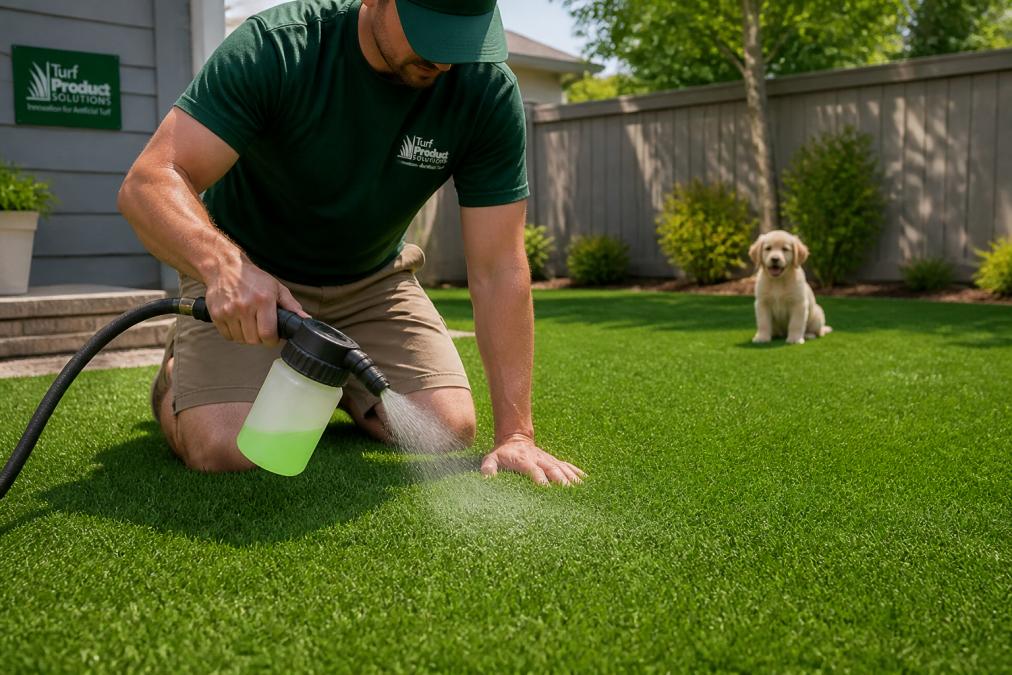
At Turf Product Solutions, we built our Turf Animal cleaner around this exact problem.

Step 4: Let the Cleaner Dwell and Break Down Odor
Enzyme cleaners need contact time to work. Dwell time is the period the product sits on the turf before you rinse it. Skip this step and you waste the product.
Follow this sequence:
- Apply the cleaner evenly over the area
- Let it dwell per the label directions
- Rinse thoroughly with water
- Allow the turf to dry completely
- Repeat for old or heavy odors
How to Remove Dog Urine Smell from Artificial Grass
Removing dog urine smell from artificial grass means breaking down the uric acid, not masking it. Air fresheners and scented sprays hide the smell for a day, then it returns.
To remove it for good:
- Rinse the area to dilute surface urine
- Apply an enzyme cleaner that digests uric acid
- Give it full dwell time
- Rinse again and let the turf dry
- Repeat on heavy or old spots
Is Bleach Safe for Artificial Grass?
No. Bleach is not safe for artificial grass. It breaks down turf fibers, fades color over time, and is harsh on paws and not meant for pet-waste cleanup.
(1 Gallon) Turf Animal ORIGINAL →
What Bleach Actually Does to Turf Over Time
Most guides say "don't use bleach" and move on. The mechanism matters: the damage is cumulative and often invisible until it's expensive.
Why Ammonia Cleaners Are Just as Bad
Ammonia-based cleaners are a common mistake because ammonia is what you smell in old urine, so it feels like the right target. It isn't: they add more ammonia, attack the backing coating like bleach does, and leave a residue that attracts pets back to the same spot.
What to Use Instead
- A pet-safe enzyme cleaner
- Plain water for rinsing
- A soft brush for light agitation
Bleach may kill surface bacteria, but it leaves the uric acid behind. The smell returns once the bleach fades. Enzymes solve the actual cause.
If You've Already Used Bleach
Don't panic, but do act. Rinse the area thoroughly with plain water to flush the residue, let it dry completely, then apply an enzyme cleaner with full dwell time. Repeat if odor persists, and keep bleach off the turf entirely, the damage compounds, and UV stabilization or backing coating can't be restored once it's gone.
Brushing, Infill Care, and Long-Term Turf Maintenance
Brushing keeps the turf upright, spreads infill evenly, and lifts debris that traps moisture and odor. It's the routine step most owners skip, and the one that protects your investment.
How Each Infill Type Traps Odor
Silica sand. The most common infill. Sand is non-porous, so it doesn't absorb urine, liquid passes through to the backing, meaning no odor buffering at all: urine pools at the backing until it drains or evaporates. Sand-heavy systems need thorough backing saturation, not just surface spraying.
Matching Your Cleaning Method to Your Infill
- Sand: Saturate the backing fully. Surface spray alone won't reach the urine.
- Zeolite: Use enzyme cleaner on a regular schedule, not just after accidents. Saturated zeolite stops working.
- Rubber: Brush before and after cleaning so granules don't mat and trap residue.
- Organic: Shorten your treatment interval and plan on replacing infill more often.
A simple weekly routine that works across infill types:
- Spot-clean accidents right away
- Rinse high-traffic areas once a week
- Apply enzyme cleaner to problem zones monthly
- Brush the turf to lift flattened fibers and redistribute infill
- Check drainage and clear any blockages
- Top up infill where it has shifted or broken down
For large areas, a battery-powered turf broom saves hours. Turf Product Solutions makes the 40V Turf Power Sweep for exactly this, with no gas, no fumes, and no pull-start. It's light enough for a homeowner and tough enough for a landscaping route.
Seasonal Shifts Change the Schedule
Humidity and temperature change how fast urine breaks down and how strongly it smells. Humid weather keeps moisture in the backing and infill longer, giving bacteria more working time. Dry heat concentrates urine and releases ammonia faster. Cold weather means slower drying, so rinse less but watch drainage, trapped moisture can freeze and damage the backing.
Common Mistakes to Avoid When You Sanitize Artificial Turf
Most cleaning failures come down to a few repeated errors. Fix these and your turf stays fresh longer.
Other mistakes to avoid:
- Skipping the dwell time and rinsing too soon
- Cleaning only the visible spot, not the full area
- Hosing solids into the turf before scooping
- Letting waste sit overnight
- Ignoring the infill and backing
- Skipping brushing and drainage checks
- Using too much water and flooding the drainage layer
| Mistake | Fix | Why It Matters |
|---|---|---|
| Using bleach or ammonia | Switch to a pet-safe enzyme cleaner | Protects fibers and paws |
| Rinsing before dwell time | Let the cleaner sit per label | Enzymes need contact time |
| Cleaning only the spot | Treat the full run or area | Urine spreads under the surface |
| Skipping brushing | Brush weekly to lift fibers | Prevents odor and matting |
| Ignoring infill | Clean and top up infill | Infill traps urine and bacteria |
Get these five right and most odor problems disappear.
Frequently Asked Questions
What is the best way to sanitize artificial turf after a puppy accident?
Remove solid waste immediately, then rinse the area thoroughly with water to dilute urine and reach the turf backing. Apply a pet-safe enzyme cleaner, such as Turf Animal, and let it dwell for 10-15 minutes so the enzymes can break down uric acid crystals and bacteria. Finish with a second rinse. This four-step process neutralizes odors at the source instead of masking them.
Can I use bleach to clean dog urine off artificial grass?
No. Bleach is not safe for artificial grass. It can damage turf fibers, break down infill, and leave harmful residue that irritates your puppy's paws. Enzyme-based cleaners are the recommended alternative because they digest organic waste without harming the turf or your pet.
How do you get the smell of dog pee out of artificial turf?
The smell comes from uric acid crystals that bind to turf fibers and backing. Regular rinsing alone won't remove them. Use a live enzyme cleaner specifically designed for artificial turf. Saturate the affected area, allow 10-15 minutes of dwell time, then rinse. For stubborn spots, apply a second treatment. A weekly deep clean of high-use areas prevents ammonia buildup and keeps odors from returning.
How often should I sanitize my artificial turf if I have a puppy?
Spot-clean immediately after every accident. For high-use areas, do a weekly deep clean with an enzyme cleaner, and apply a more thorough sanitization monthly. This schedule prevents odor from settling into the backing and reduces bacterial growth. Puppies have frequent accidents, so staying proactive is key to keeping turf fresh and hygienic.