
Table of Contents
- 2026 Turf Deodorizer Spray Comparison: Top Picks at a Glance
- How to Remove Dog Urine Smell from Artificial Turf: Step-by-Step
- Enzyme Cleaner for Artificial Turf: How It Works and Why It Matters
- Turf Animal Product Reviews: Which Formula Fits Your Yard?
- Artificial Turf Maintenance Tips for Long-Term Odor Prevention
- Safety, Runoff, and Turf Integrity: What the Labels Don't Tell You
- Frequently Asked Questions
Last Updated: September 16, 2026
2026 Turf Deodorizer Spray Comparison: Top Picks at a Glance
Finding a pet safe turf deodorizer spray reviews 2026 that eliminates odor instead of covering it up comes down to one thing: whether the formula breaks down the source or just perfumes the surface. Turf Product Solutions built its Turf Animal line around live enzymes and plant-based surfactants for that reason. Most sprays fail within a week because they never touch the bacteria in the turf backing.
| Product | Format | Coverage | Price | Best For |
|---|---|---|---|---|
| Turf Animal Original (1 Gallon) | Concentrate | Up to 8,000 sq ft | $44.96 | Homeowners with heavy odor areas |
| Turf Animal Pro Strength Starter Pack | Eco Bag + sprayer | ~5,000 sq ft | $54.95 | First-time bulk buyers |
| Turf Animal Original (3 Pack Quart) | Concentrate + sprayers | 3,750 sq ft total | $49.95 | Small yards and spot treatment |
| Turf Animal Pro Strength (4 Pack Refill) | Eco Bag refill | ~9,000 sq ft | $94.95 | Pet facilities and installers |
How to Remove Dog Urine Smell from Artificial Turf: Step-by-Step
The reliable way to remove dog urine smell from artificial turf is to flush waste out of the backing and infill, then digest what remains with an enzyme formula. Surface spraying alone rarely works because urine drains downward, out of a spray bottle's reach.

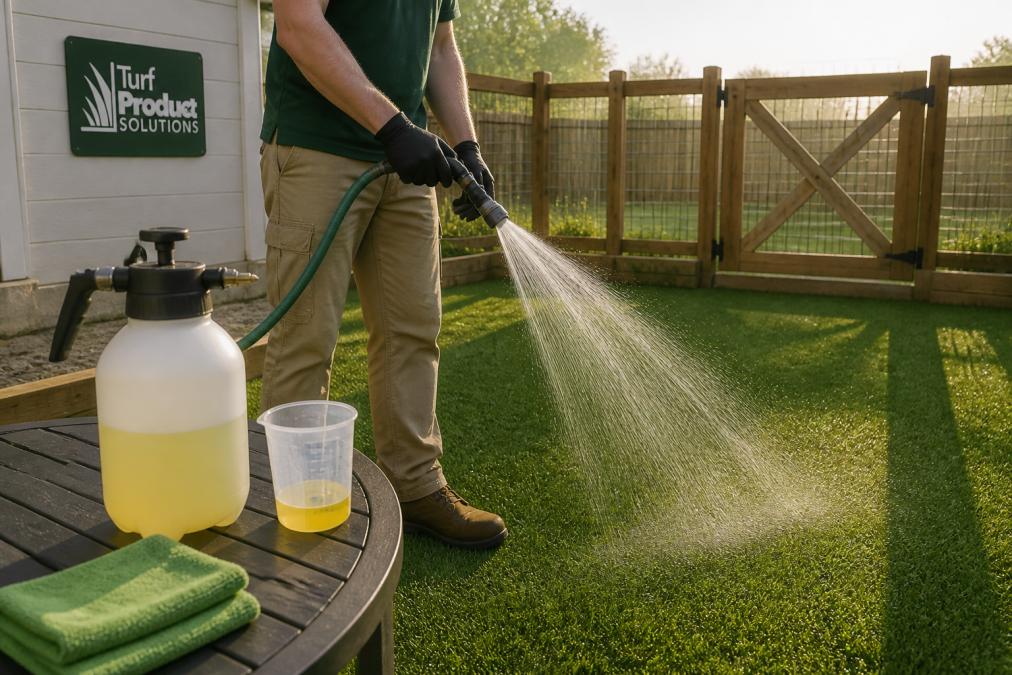
Here is the sequence that works:
- Remove solids first. Pick up fecal matter and debris before applying anything wet.
- Saturate, don't mist. Apply diluted cleaner until it soaks through the blades into the backing; a light mist evaporates before reaching the odor source.
- Let it dwell. Give the enzymes time to work on uric acid and bacteria, rushing this is the most common mistake.
- Flush with water. Push broken-down residue through the drainage system so it does not re-settle.
- Dry completely. Moisture left in the infill is where odors rebuild.
Why Surface Spraying Fails on Deep-Set Odors
Odors return because they are trapped in the turf backing or infill. Simply spraying the surface is often ineffective without proper drainage or specialized infill like Zeolite, according to TurFresh guidance on turf odor sources.
The Role of Drainage and Infill in Odor Control
Drainage and infill decide whether odor becomes chronic or a one-time fix. Turf that drains poorly holds moisture, keeping odor-producing bacteria active.
Enzyme Cleaner for Artificial Turf: How It Works and Why It Matters
An enzyme cleaner for artificial turf uses live bacteria and enzymes to digest odor-causing organic compounds rather than masking them with fragrance. That is why enzyme formulas keep working after the bottle is empty while masking sprays stop the moment they dry.
Enzymatic vs. Oxidizing vs. Masking Formulas
Three formula types dominate the shelf, and they behave very differently.
- Enzymatic: Digests organic waste at the molecular level. Slower to act, longer lasting, safe for pets once dry.
- Oxidizing: Uses hydrogen peroxide or similar agents to break down compounds chemically. Fast, but can fade turf color with repeated use.
- Masking: Fragrance and surfactants only. Instant results, zero effect on the source.
Turf Animal Product Reviews: Which Formula Fits Your Yard?
Turf Animal is the only turf cleaner formulated to Whole Foods eco-ingredient standards, built on plant-based enzymes and natural surfactants rather than harsh oxidizers. The line splits into ready-to-dilute concentrate and Eco Bag refills, a coverage question, not a quality question.

Turf Animal Original Concentrate (1 Gallon)
The one-gallon concentrate is the entry point for most homeowners. One gallon treats up to 8,000 sq ft for heavy odor areas, covering a typical backyard dog run several times over.
Turf Animal Pro Strength Eco Bags (Starter Pack and Refills)
For a landscaping business maintaining turf for 15 to 20 clients, the four-pack refill is the practical choice, and the subscription option reduces cost further.
Artificial Turf Maintenance Tips for Long-Term Odor Prevention
Artificial turf maintenance tips matter more than any single product choice, because odor control is a schedule, not an event. Turf cleaned on a routine stays odor-free with less product; turf cleaned only when it smells requires far more. The same schedule also protects the backing, infill, and drainage layer that determine how many years you get out of the install.
A Maintenance Schedule That Protects the Turf, Not Just the Nose
- Daily: Remove solid waste immediately, the longer it sits, the deeper it soaks.
- Weekly: Rinse high-traffic zones to push residue through drainage. If water pools for more than a few minutes, drainage is the bottleneck and no spray will fix it.
- Monthly: Apply enzyme cleaner across the full surface, not just the worst spots, odor bacteria colonize the whole drainage field.
- Quarterly: Brush up matted fibers with a stiff-bristle (not wire) broom. Matting compresses infill and slows drainage, the most common cause of chronic odor.
- Seasonally: Check that infill is level. Low spots collect moisture and waste; top off with the same infill type.
- Annually: Inspect the perimeter drain and perforated lines. A clogged drain turns a well-maintained lawn into a wet sponge within a season.
Why Drying Time Is the Whole Game
Odors frequently intensify when turf remains wet, and failing to let turf dry completely after cleaning or rain can make the smell worse regardless of the product used, according to r/landscaping discussion on turf odor. That single habit, drying time, separates yards that stay fresh from yards that never quite do.
(1 Gallon) Turf Animal ORIGINAL →
The Long-Term Turf Integrity Angle
The choices you make for odor control compound over the life of the install.
- Oxidizer-heavy routines fade blades and stress the polyurethane secondary coating. The visible symptom is color loss; the invisible one is tuft pull-out two or three seasons in.
- Soap-based routines leave surfactant residue that traps organic matter, feeding the next bacterial bloom and driving you to use more product, a cycle that shortens infill life.
- Enzyme routines work on the waste and rinse clean. Over five years, the difference shows up in how the turf looks and drains, not just how it smells.
A Note on Frequency
Most residential yards with one or two dogs do well on a monthly enzyme application plus weekly rinses. Multi-dog households, dog runs, and kennels typically need every two weeks during warm months. The signal to increase frequency is not smell, it is how long the yard stays damp after a rinse.
Safety, Runoff, and Turf Integrity: What the Labels Don't Tell You
Safety claims on turf cleaners deserve scrutiny, because "pet-safe" is not a regulated term. What matters is the ingredient list, the pH, and the runoff, and most reviews stop at the first item.
Reading the Ingredient Panel Like a Formulator
Four ingredient families show up in turf deodorizers, and they behave very differently on synthetic grass:
- Enzymes and live bacteria. Break the chemical bonds in uric acid, urea, and sulfur compounds, and consume the residue. They work on the waste, not the turf, and are the gentlest option for backing and infill.
- Oxidizers (hydrogen peroxide, sodium percarbonate, sodium hypochlorite). Fast breakdown of odor compounds, but repeated use attacks the polymer chains that give blades their color and UV stability, dulling or chalking the surface over a season.
- Quaternary ammonium compounds (quats). Effective on bacteria, but leave residue that can irritate paws and, at higher concentrations, degrade backing adhesives.
- Surfactants and fragrance. Plant-based surfactants help actives penetrate infill; synthetic fragrance and dye add nothing to odor control and are the most common cause of paw irritation complaints.
What Actually Happens to the Runoff
Whatever you spray ends up somewhere. On a typical residential install, water moves through the turf backing into a base layer of crushed aggregate, then into a perforated drain line or down into the soil, from there it can reach garden beds, storm drains, and in some municipalities surface water. That pathway is why runoff matters more for turf cleaners than for a bathroom spray.
- Avoid persistent antimicrobials. Ingredients that stay active in soil for weeks can affect microbial life in garden beds adjacent to the turf. Biodegradable, plant-based formulas break down faster in the base layer.
- Watch the drain destination. If your turf drains to a storm sewer rather than a sanitary sewer, anything you apply effectively goes to surface water. Check with your local public works department if unsure which system your yard ties into.
- Do not over-apply. More product does not mean more odor control. Once the enzyme load exceeds the waste load, the excess rinses through, carrying surfactants and fragrance with it.
Turf Integrity: The Cost Most Reviews Ignore
Artificial turf is a layered system: blades, a primary backing, a secondary coating (usually polyurethane), and infill. Each layer reacts differently to chemistry.
- Blades are UV-stabilized polyethylene or polypropylene. Oxidizers and high-pH cleaners accelerate UV degradation, showing up as fading and brittleness two to three seasons early.
- Primary backing is a woven or non-woven fabric. Strong solvents or high-pH cleaners can weaken the weave and cause tuft loss under foot traffic.
- Secondary coating is the polyurethane layer that locks tufts in place, the layer most vulnerable to chemical attack, and the one you cannot see or repair.
- Infill (silica sand, crumb rubber, or coated antimicrobial sand) can hold residue. Soap-based cleaners are the worst offender because residue traps organic matter and feeds the next bacterial bloom.
DIY vs. Professional-Grade: Setting Expectations
Household remedies, white vinegar, baking soda, diluted dish soap, get recommended constantly, and they are not useless. Vinegar is mildly acidic and can neutralize some surface odor compounds; baking soda absorbs moisture and some odor. The limits are real:
- Vinegar lowers pH at the surface but does not penetrate the backing where urine collects, and repeated use can stress the secondary coating.
- Baking soda is a surface treatment that does nothing for waste already in the infill.
- Dish soap is the one to avoid, it leaves surfactant residue that traps organic matter and makes the next odor worse.
Frequently Asked Questions
What is the best artificial turf deodorizer for pets?
The best options use live enzymes and plant-based surfactants rather than heavy fragrances or harsh oxidizers. Turf Animal Original is a standout because it's pH-balanced to protect synthetic fibers, free from sulfates and synthetic dyes, and concentrated enough that one gallon treats up to 8,000 square feet for heavy odor areas. It digests odor-causing bacteria at the source instead of masking smells, which matters for long-term odor control.
How do I stop my artificial turf from smelling like dog urine?
Start by thoroughly rinsing the area to dilute urine, then apply an enzyme cleaner for artificial turf that breaks down uric acid crystals trapped in the turf backing and infill. Allow complete drying between applications, because moisture intensifies odors. If the smell persists after two treatments, check your drainage system and consider a Zeolite or antimicrobial infill to prevent future odor buildup at the base layer.
Are enzyme-based turf cleaners safe for dogs?
Enzyme cleaners formulated for artificial turf are generally safe for pets when they use plant-based enzymes and avoid harsh chemicals like quats or heavy oxidizers. Turf Animal, for example, is pH-balanced, free from sulfates, dyes, and synthetic perfumes, and designed to be safe for kids, pets, and the planet. Always let the turf dry completely before allowing pets back on the surface, and follow the product's dilution instructions.
How often should I apply deodorizer to artificial grass?
For homes with one or two dogs, a monthly application of a concentrated enzyme cleaner usually keeps odors under control. High-traffic areas like dog runs or kennels may need treatment every two weeks. During hot or humid weather, increase frequency because bacterial growth accelerates. Using a hose-end sprayer with a product like Turf Animal Pro Strength Eco Bags makes routine application fast and consistent.
Can I use household vinegar to clean pet urine from turf?
Vinegar can neutralize some surface-level ammonia smells, but it doesn't break down the uric acid crystals that cause recurring odors in artificial turf. It also lowers pH temporarily, which repeated use could affect turf fibers. For deep-set pet urine odor, an enzyme-based cleaner that digests the waste at a molecular level is more effective and safer for synthetic grass over the long term.